description: "Adds deterministic Markdown presentation and local editing aids to a DSH Web Composer without taking ownership of source or submission." kind: "package-bundle"
@cheesefox/dsh-better-composer
English | 中文


Summary
DSH Better Composer adds source-preserving Markdown presentation, fixed local completion candidates, and diagnostics to a DSH Web Composer. The profile layer contributes Settings and editor presentation through the public DSH composer seams. DSH Core remains the owner of source, selection, history, Context Objects, and Send/Queue/Steer. Long pastes can convert into editable reference chips whose LLM-assisted rewriting runs as an independent one-shot call outside the session event stream.
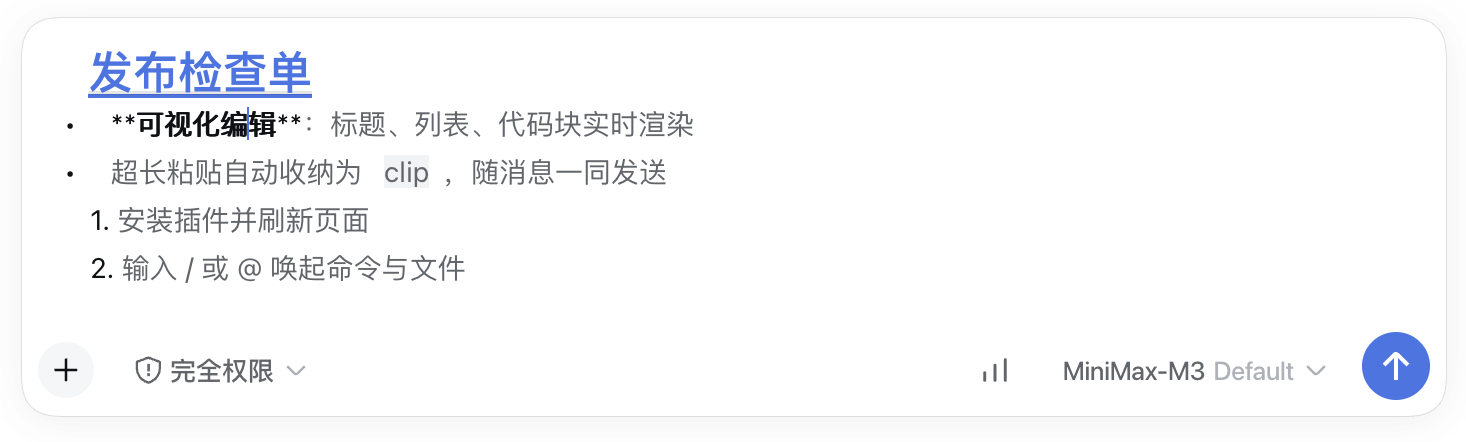
Table of Contents
- Use this package
- Understand the implementation
- Further Exploration
- Model Experience
- Known Limitations and Deferred Work
- Dev Note
Use this package
Requirements
- A native DSH installation with the
webprofile available. - DSH
0.1.7-alpha.2or a newer release that satisfies the peer dependencies in this package. The release tested against the source tree is@deepseek-ai/dsh@0.1.7-alpha.2. - Node.js
>=20and pnpm>=10. - A workspace directory that DSH can open. File-mode pasted clips need a known workspace path.
Check the native installation before adding the plugin:
dsh --version
dsh web --no-open
Stop the temporary web process after confirming the page opens, then install the plugin into the profile you use to run Web DSH.
Install the published package
pnpm dsh plugin --profile web add @cheesefox/dsh-better-composer@1.0.0
pnpm dsh web --no-open
Open the Web URL printed by DSH. Go to Settings → Built-in plugins → Better Composer to verify the plugin contribution is loaded. Create a new session and confirm the Composer overlay and the + menu are present.
Install directly from GitHub source
git clone https://github.com/CheeseFox259/dsh-better-composer.git
cd dsh-better-composer
pnpm install
pnpm run bundle
cd ..
pnpm dsh plugin --profile web add ./dsh-better-composer
pnpm dsh web --no-open
The source install is useful for development and always uses the current checkout. It does not modify DSH Core; the package is a profile bundle patch plus Host/Client plugin entries.
Verify the first installation
- Open a new session in the Web UI.
- Paste text longer than the configured threshold and confirm it becomes a
粘贴文本chip. - Open the chip and select 文件送达. Choose a text or code extension in the 文件类型 selector, then save an edit and confirm the file is written under
.dsh/pastes/when the message is sent. - In the clip editor, test 撤销 and 重做 after manual edits and after applying an LLM rewrite preview.
- Open Settings → Built-in plugins → Better Composer and adjust the long-paste threshold. The file extension is selected per clip, not in global Settings.
Remove the plugin
pnpm dsh plugin --profile web remove @cheesefox/dsh-better-composer
Restart Web DSH after changing profile composition. Removing the plugin removes its overlay, Settings card, clip source, sidebar tab, and Remote contribution; it does not modify existing DSH session history or Core source.
The package is a dsh.bundle.patch profile layer. The patch inserts one dsh-better-composer row into the active profile. The client entry is loaded only on the Web platform and depends on the public conversation, renderer, Settings, and Settings-plugin packages declared in package.json. The package's peer lower bound is 0.1.7-alpha.1; the release verification uses native DSH 0.1.7-alpha.2.
What you get
Markdown visual enhancement for headings, emphasis, links, task lists, quotes, tables, fenced code, and source-preserving attachment labels.
Deterministic local completion for approved fence-language, task-marker, and heading-spacing candidates, plus a bounded ghost for approved prompt-section headings.
Non-blocking diagnostics for the supported incomplete Markdown constructs.
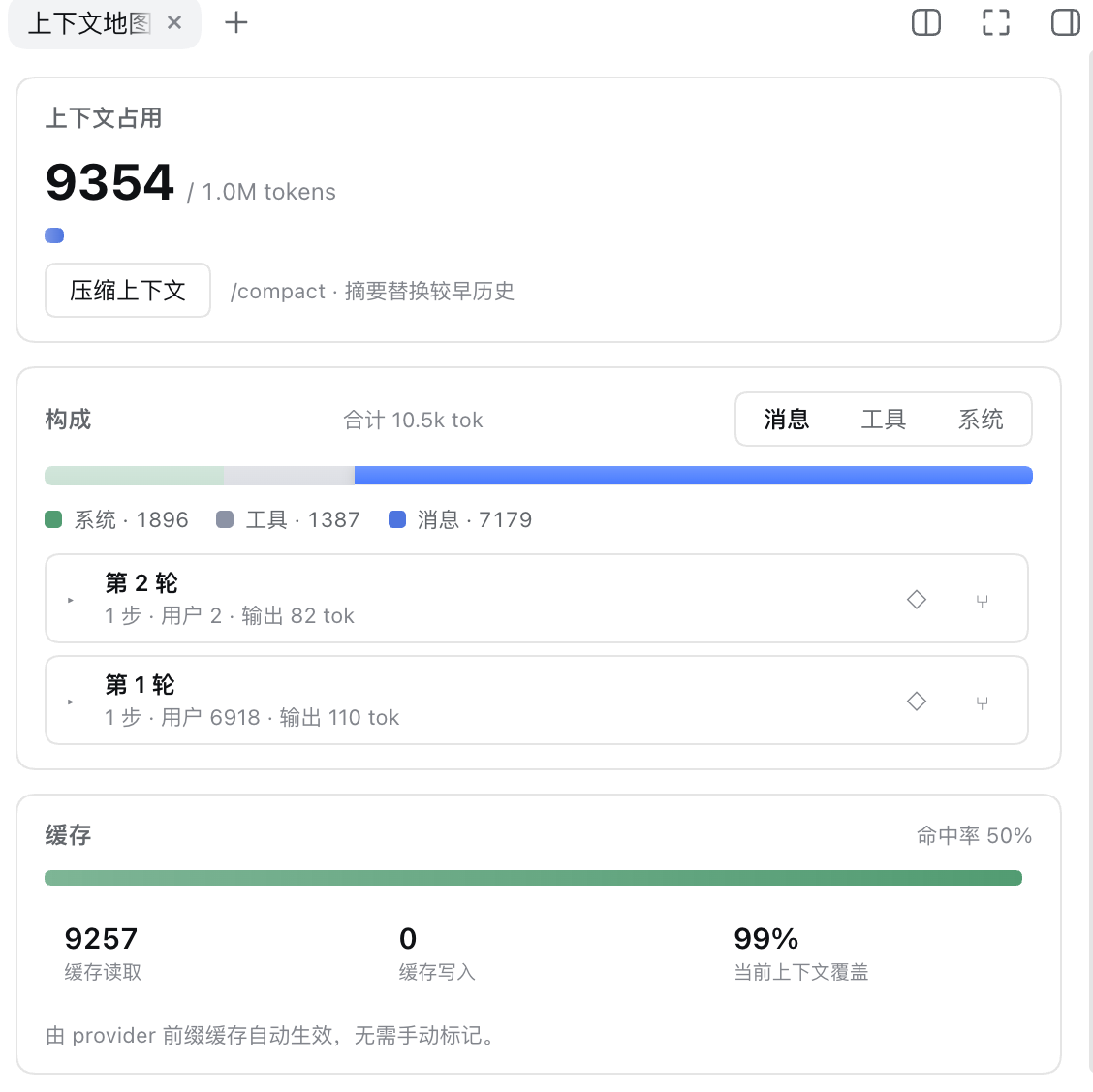
Context map (composer toolbar icon opens the right sidebar): occupancy gauge (measured tokens / model window), composition stack, structure stats, and per-turn growth — all push-updated live, computed over the full session history rather than the currently loaded window. The composition card drills down 消息 → turn → step (trace) → full message text, and each bar in the growth chart opens a per-turn breakdown (user/assistant tokens, tool calls, files and images) with one-click anchoring and jump-to-message; the system prompt and tool inventory (from request/header) are viewable in full.
Context management: run
/compactin-place (with confirmation and a compacting state; compaction checkpoints are marked on turns); fork a new session after any closed turn; pin turns as anchors shown as gold ticks on the growth chart.Cache visualization: hit rate, current-context cache coverage, and read/write tokens (provider prefix caching, automatic).
Long-paste conversion into an editable "pasted text" chip (threshold adjustable in Settings; 0 disables): delivery is selectable per chip — inline into the prompt at submit time, or materialized as a workspace file and referenced with the official
@pathfile-reference syntax. The workspace file extension is selectable in the clip editor from a fixed text/code list. Clicking the chip opens a right-sidebar editor supporting manual edits and instruction-driven LLM rewriting with cancellation, preview, apply, undo, redo, and retry (a one-shot call outside the session event stream, optionally carrying recent session messages and the current reasoning effort as reference).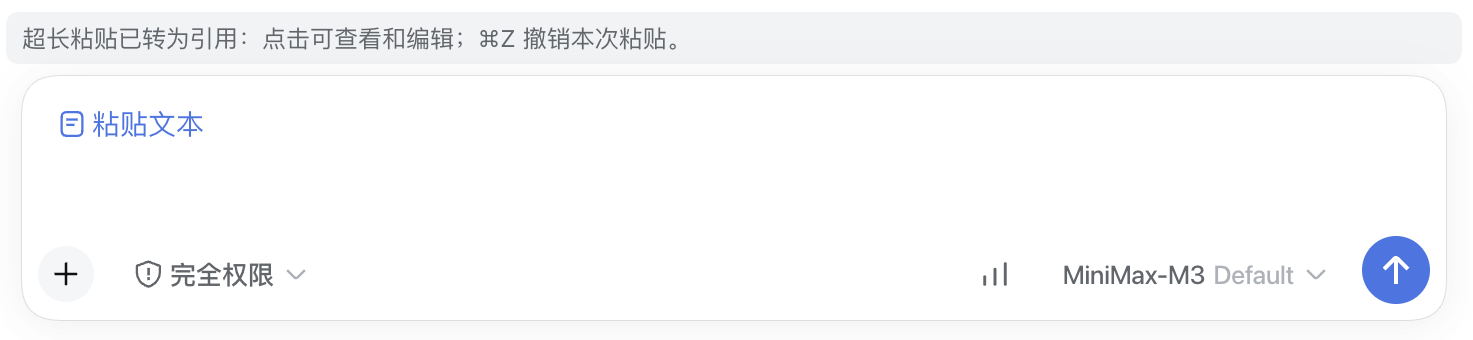
Four Settings controls: enable Better Composer, Markdown visual enhancement, Markdown syntax hints, and the long-paste threshold. The per-clip workspace file extension is selected in the clip editor. The legacy
toolbarModefield remains schema-compatible and is not a separate UI toggle.
Understand the implementation
Implementation internals — click to expandThe Host entry in src/index.ts installs the Settings schema, the client bundle, and the betterComposer Remote service (@Remote runtime markers, no generated artifacts). cordis.patch.yml adds the bundle to a profile. src/client/index.ts owns effect-scoped registration and disposal for Settings, decorations, actions, the editor surface, the Settings card, the clip source, and the right-sidebar tab.
The Markdown provider parses the authoritative Composer snapshot and emits UTF-16 source ranges. The editor surface presents those ranges through Core's generic decoration and surface-extension seams. Completion acceptance and language changes use the existing Core transaction path. Ghost text, diagnostics, tables, and code controls are presentation only; they never create a second source, selection, history, Context Object, or submission path.
Paste clips (@clip:<id>) work by detecting a single-revision length jump via prefix/suffix diff, replacing the inserted span with a chip through the public setDraft(text, references) verb, and expanding the chip at submit time through a registered inputTriggers codec — either the full text (inline) or a workspace file reference such as @.dsh/pastes/pasted-text-<id>.md (file mode, where the Host writes the text under <cwd>/.dsh/pastes/). Clip payloads persist under the harness home so reloads never lose them. The right-sidebar editor registers through sidebarRightTabs + sidebar.right.pane.tab; its LLM rewrite calls the Host editText Remote method with an independent purpose, current model reasoning effort, cancellation, and preview/apply state, and appends nothing to the session event log.
Further Exploration
src/settings.ts— persisted Settings fields and defaults.src/client/editor.tsx— editor presentation and interaction wiring.src/client/presentation-layout.ts— table and code presentation layout.src/markdown/provider.ts— source ranges and Markdown presentation data.tests/— focused parser, lifecycle, Settings, completion, diagnostics, and presentation tests.
Model Experience
A file-mode clip reaches the model as an official-style workspace file reference (@.dsh/pastes/...); the file is available to the Agent's normal file tools, while an inline clip splices its full text into the user message. The LLM rewrite runs outside the session: the model sees only the clip text, the instruction, the optional recent-message excerpt, and the current reasoning effort passed explicitly by the plugin — never the session event stream. Results are previewed before they replace the clip.
Known Limitations and Deferred Work
The host must provide the declared public composer, Settings, input-trigger, right-Sidebar, and Remote seams; an older host missing one disables only that capability. The supported code-language and pasted-file-extension lists are finite and local. File-mode delivery requires a known session workspace path; clips created before cwd capture fail file-mode sends with an explicit error rather than silently. Pure plugin code cannot create Core's opaque attachment receipts, so file-mode clips use the official workspace @path reference convention rather than pretending to be native binary attachments. Paste detection cannot distinguish a paste from any other large single-step insertion (IME commits, undo); the threshold limits but does not eliminate false positives. Markdown list line-break completion (auto-continuing list markers and exiting on Enter / Shift+Enter) is currently deferred to native DSH Core logic. Under the zero-core-modification constraint, Core operates on Lexical Plain-Text without exposing paragraph-level transactional edit seams; intercepting this via public APIs or the DOM causes underlying data model divergence, selection collapse, and visual desync. For a detailed architectural analysis and upstream seam proposals, see Issue #1 (RFC). Browser acceptance belongs to the host release process; this repository's automated checks do not replace a maintainer's real-browser review.
Dev Note
Working context for maintainers — click to expandThe package uses the existing DSH profile bundle mechanism and local package scripts. Run pnpm test, pnpm run typecheck, pnpm run bundle, and pnpm run pack:check from this directory.
No comments yet. Be the first to write one.