English · 简体中文
DeepSeek Harness Ultracode



One switch. Maximum depth.
dsh-ultracode adds an ultra tier to DeepSeek Harness: one per-session switch that pins every model request to the serving model's deepest reasoning effort and activates a standing orchestration policy — workflow fan-out by default on substantive tasks, adversarial verification before reporting, context hygiene. Delegated children inherit the tier as a worker policy (deep effort, adversarial verification) without the workflow mandate, so orchestration stays at the top.
Modeled on Claude Code's ultracode tier: the tier's substance is the standing orchestration policy, not a deeper reasoning parameter. Works on any provider whose adapter declares efforts from the shared vocabulary — DeepSeek (max), GLM / Kimi routes (high or max, whichever the model declares), or fully custom OpenAI-compatible routes.
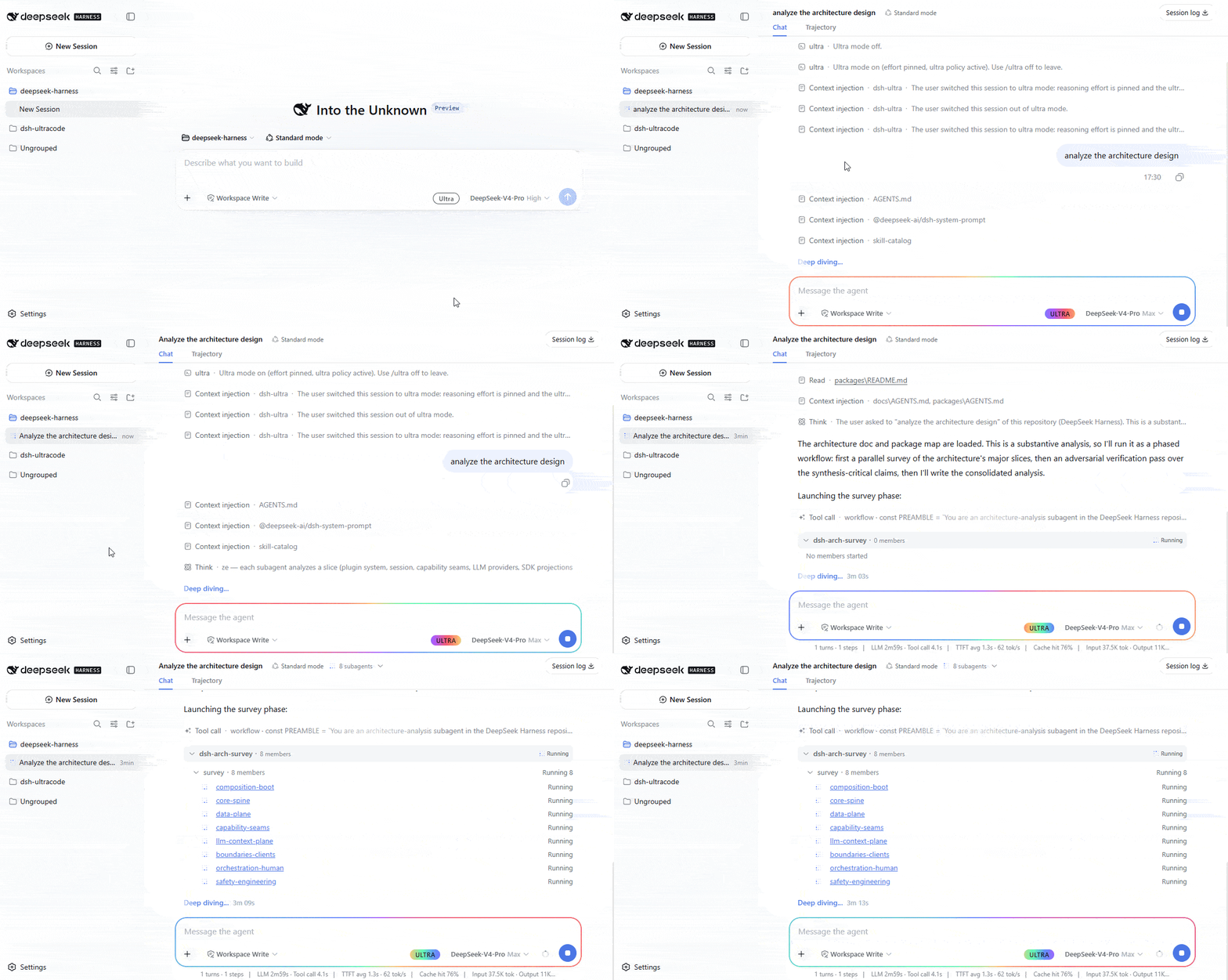
Toggle it from the composer: a ULTRA chip appears next to the model selector, and while active the composer card carries an animated rainbow border.
What it changes
| Capability | What it changes |
|---|---|
| Per-session effort tier | One switch pins every model request to the serving model's deepest declared effort (auto), or a literal configured value. |
| Orchestration policy | A deployment-owned prompt section rides the system prompt while active: standing workflow opt-in, adversarial verification, narrow-the-wave retries on provider limits — for the top-level session. |
| Composer chip + rainbow border | A ULTRA chip in the composer bar; the composer card glows while the tier is in force (static under prefers-reduced-motion). |
| Picker consistency | The host records the effort through agent.model.select(), so the native picker follows the same durable selection as model requests. |
| Delegation-aware | Spawn subagents inherit the effective state through the delegation chain — the effort pin and a worker policy (childSection), never the workflow mandate; forks inherit through their seeded prefix and freeze there. |
Install
[!NOTE] Requires DeepSeek Harness
0.2.2-alpha.2or a compatible release (@deepseek-ai/dsh-*@^0.2.2-alpha.2) and Node.js>=24.9.0.
npm
dsh plugin --profile <name> add dsh-ultracode
Build from source
git clone https://github.com/BackMountainBird/dsh-ultracode.git
cd dsh-ultracode
pnpm install
pnpm build
dsh plugin --profile <name> add .
Run pnpm build again after changing the source. The local plugin install remains linked to this checkout.
Validate the composed profile and restart DSH:
dsh --profile <name> --dump-config
dsh --profile <name> web
Then switch the tier on — from the composer chip, or directly:
/ultra
Use ultra mode to audit every integration point of this repository against its pinned dependencies, with parallel verification.
Leave with /ultra off (or click the chip again).
How it works
- The switch is one command.
/ultra(and/ultra off) execute through the harness command runtime, which appends thecommand/runsession event before the handler runs. That event is the durable switch state, so resume and replay restore it, and the last command wins. A validated, ignorableplugin:dsh-ultracode/effort-pinrecord tracks which explicit selection the plugin owns; reload and resume can release an inherited pin without overwriting a later manual choice. - The policy rides the system prompt, gated by delegation depth. While active, an
ultra:policysection renders into every request. The top-level session (delegationDepthzero) renderssection: the orchestration policy (standing workflow opt-in, adversarial verification, context hygiene, narrow the wave when a provider's concurrency limit times parallel subagents out). A delegated child (delegationDepthabove zero) renderschildSectioninstead: a worker policy that keeps the workflow tool's default opt-in rule — an inherited mandate would make every child fan out workflows of its own, with no delegation-depth budget on the workflow path to stop it. - The effort is selected before request admission. The command and
agent/createdlistener record the serving model's deepest declared effort throughagent.model.select().auto(default) ranks the sharedoff…maxvocabulary; a literal value pins exactly and fails if the adapter does not declare it. Anagent/pre-stepcheck corrects manual changes and inherited-state changes. If the step already captured another effort, the plugin preserves its claimed messages, cancels that preparation, and wakes a new turn with the corrected selection and a notice. This may add an aborted preparation to the log; it sends no model request under the stale effort. DSH0.2.2rejects effort changes in the deprecatedagent/requestwaterfall. - Delegation inherits it. Spawn children walk the delegation chain (each child's
parentSession, resolved against the live session store) and get the pin and the worker policy — the effort resolving against the child's model. Fork children (header.isSeeded, including an empty seed) inherit only through their seeded completed-turn prefix; a parent's later switch never reaches an already-spawned branch. - The model is told. Each genuine switch injects one notice user message attributed to the
dsh-ultracodeproducer, so the model learns the change without diffing prompt sections. - The picker follows. The host's durable model selection updates the native effort picker. The chip only executes the command; it makes no second model-selection request that could overwrite a fixed
effortconfiguration. Switching off clears the explicit effort and restores the adapter default. - The web half is one client bundle. A ULTRA chip occupies the composer's
conversation.input.rightseat; state rides the host-computedultraprojection (zero client-side ultra state), and while active the chip marks the composer card — an injected stylesheet renders the rainbow border. The bundle ships as a closure factory (window.__ModuleLoader__.load) with platform externals resolved through the loader's module table.
Configuration
Profile row dsh-ultracode:
- id: dsh-ultracode
  config:
    effort: auto
| Field | Default | Meaning |
|---|---|---|
section |
built-in policy text | Rendered as the ultra:policy prompt section while active, for top-level sessions (delegationDepth zero) |
childSection |
built-in worker policy | Rendered instead of section for delegated children (delegationDepth above zero); the default keeps the workflow tool's opt-in rule so the mandate does not recurse |
effort |
auto |
auto pins each request to the deepest effort the serving model declares; a literal value must be one of the serving adapter's declared efforts (fails loud otherwise) |
promptSectionOrder |
120 |
Prompt-section order |
Boundaries
- The switch uses the harness-owned
command/runevent; pin ownership uses an ignorable plugin record, outside the released session-event vocabulary. The tool catalog never changes across modes (request-cache stability). - Inheritance only ever adds: subagent sessions have no user command surface, so children cannot opt out.
- The orchestration mandate does not recurse: children render
childSection(the worker policy), keeping the workflow tool's default opt-in rule — only the top-level session orchestrates by default. - Manual effort changes made mid-ultra realign before the next request is admitted; the host's recorded selection drives both requests and the native picker. A request already prepared before a switch keeps its captured selection.
- Fan-out capacity belongs to the provider: the default policy tells the model to retry timed-out parallel work as a narrower wave instead of abandoning it.
- Ultra does not touch plan mode: the two are independent logged states and compose freely (
/plan+/ultra= max-effort planning under plan's read-only constraints).
Development
pnpm install
pnpm run typecheck
pnpm run build
pnpm run verify
Host half in src/ (command, durable effort selection, step-admission check, prompt section, session projection, delegation-chain walk); browser half in src/client/ (composer chip, rainbow stylesheet, command transport). DSH peer floors are ^0.2.2-alpha.2; devDependencies pin 0.2.2-alpha.2, with Cordis 4.0.6-alpha.1 and Schemastery 3.18.6-alpha.1. Verification runs offline checks over the built host/client artifacts and the released DSH agent loop with a mock adapter.
No comments yet. Be the first to write one.