reviewd
An agent-native code review control plane.
Independent AI pre-review, line-anchored human comments, round tracking, and a clean feedback loop back to the coding agent that opened the review.


Quick start · npm packages · Features · Documentation · Agents
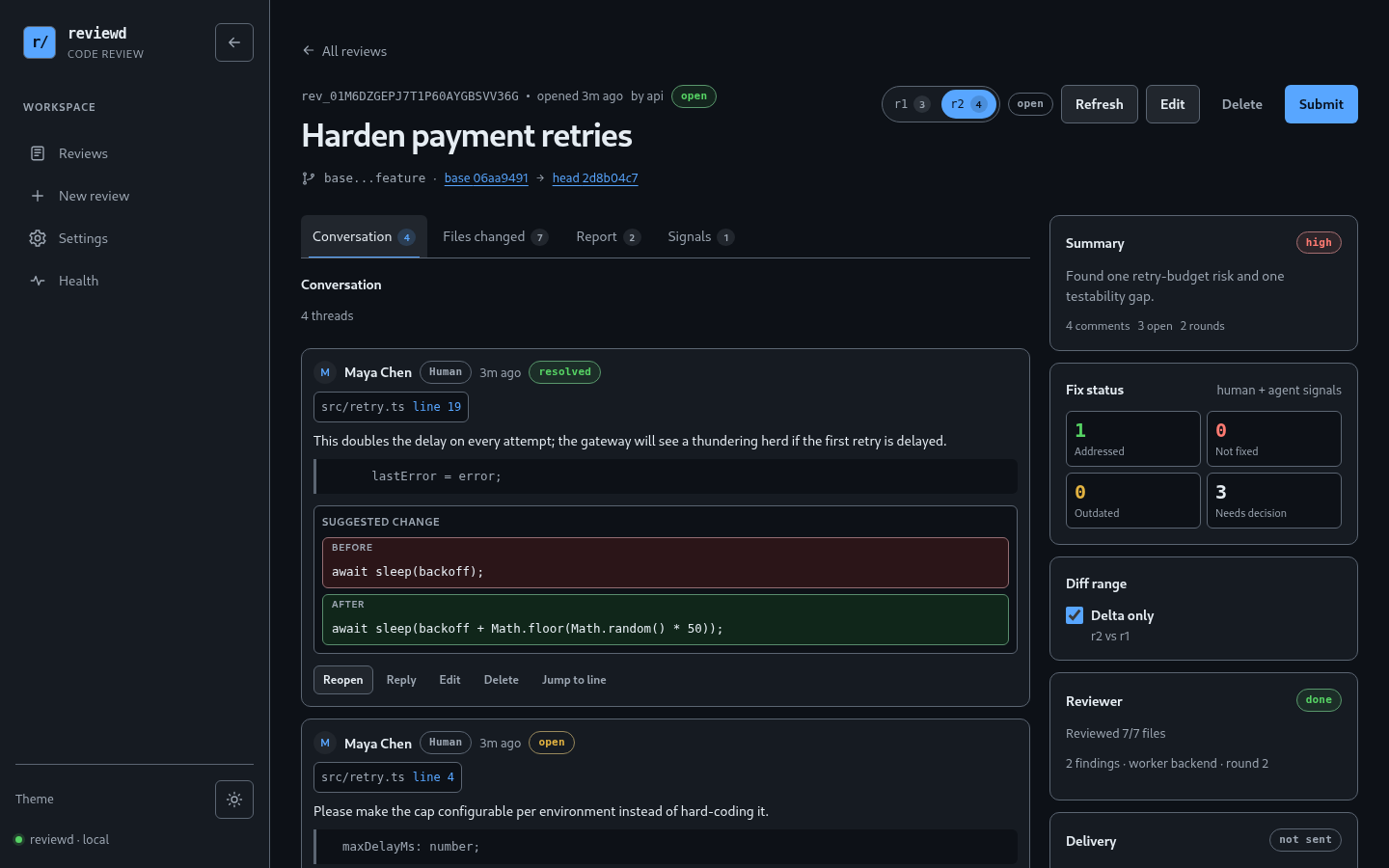
A real review after a fix round: one thread addressed, three decisions still open, and every comment still attached to its line.
See it in motion
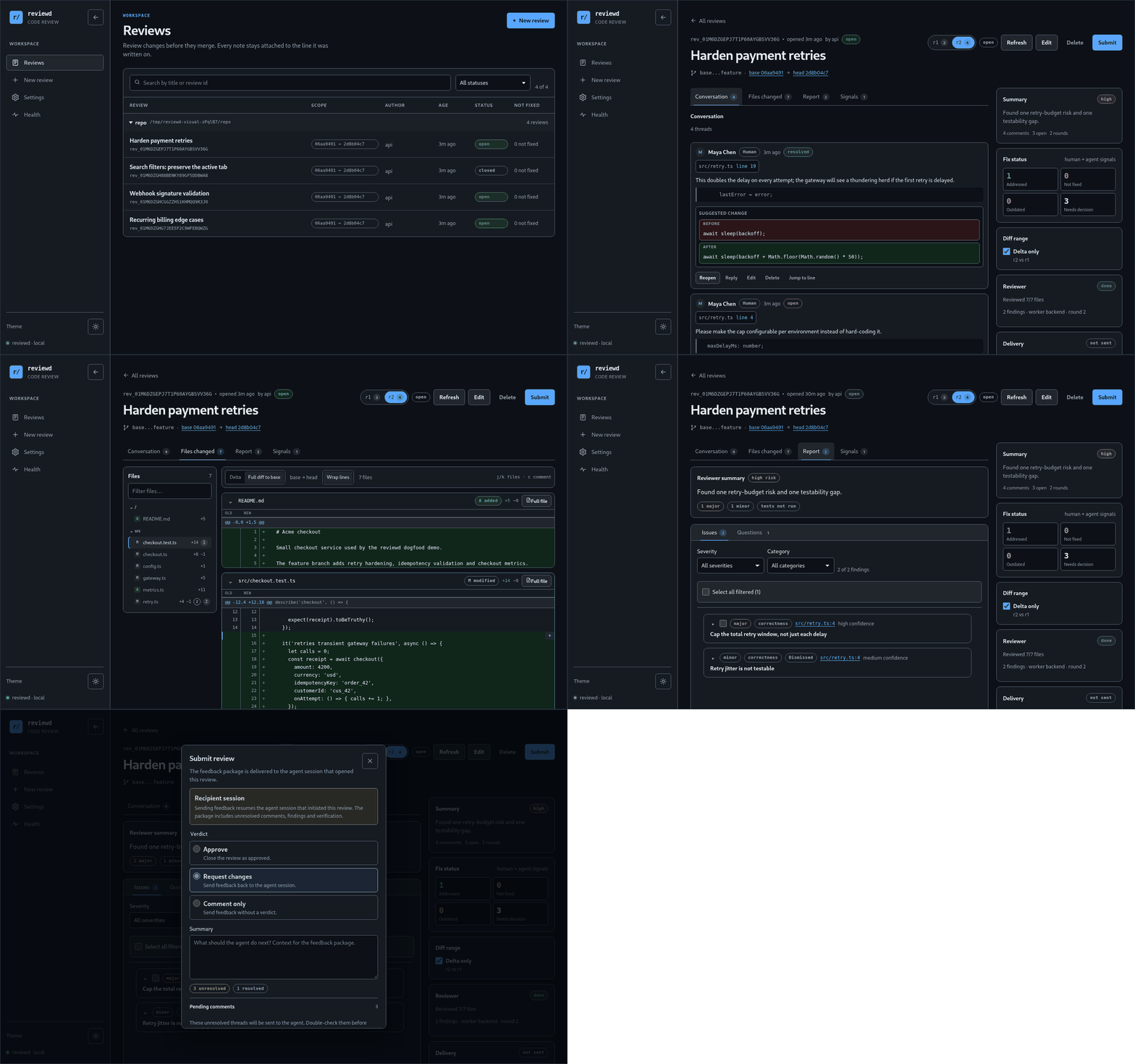
Open the 13-second WebM walkthrough · the flow from queue to handoff, recorded on the real UI.
Why reviewd
Coding agents are good at opening a change and bad at closing the loop around it. reviewd gives the change a durable review surface:
- an independent reviewer can inspect the diff before a human does;
- a human can leave precise, line-anchored comments and accept or dismiss findings;
- the next agent pass gets deterministic markdown/JSON feedback instead of a chat summary;
- every round, decision and resolution stays in an audit-friendly event log.
reviewd is self-hosted and harness-agnostic. DSH gets a native panel and tools; Claude Code, Codex, pi and a plain shell use the same authenticated CLI/HTTP contract. It is not a GitHub/GitLab replacement — it is the review layer for agent-driven work.
npm packages
The public packages are published on npm under the @sir_yami scope:
| Package | Latest | Install | Role |
|---|---|---|---|
@sir_yami/reviewd |
 |
dsh plugin --profile web add @sir_yami/reviewd |
DSH bundle |
@sir_yami/reviewd-server |
 |
npm install -g @sir_yami/reviewd-server |
daemon, API and review CLI |
@sir_yami/reviewd-core |
 |
npm install @sir_yami/reviewd-core |
TypeScript library |
These are layers, not three alternatives. Install the one that matches where the review should live.
What should I install?
| Situation | Install |
|---|---|
| Review inside DSH, with no separate service | @sir_yami/reviewd |
| DSH panel backed by a shared daemon | @sir_yami/reviewd-server on the daemon host and @sir_yami/reviewd in DSH with embedded: false |
| Standalone browser UI | Docker Compose, which includes the web build; the npm server package is API/CLI-first |
| CLI or HTTP API for agents, CI and remote machines | @sir_yami/reviewd-server |
| Custom TypeScript adapter, or embedding review state in another process | @sir_yami/reviewd-core |
What each package contains
@sir_yami/reviewd — DSH integration. Start here if you use DeepSeek Harness. The
bundle brings the sidebar panel, the review_* tools, a reviewer worker, feedback delivery
and its own SPA at /code-review. It starts the daemon in-process, so there is no separate
reviewd process to install or supervise. The bundle already contains the server and core
code it needs; installing those separately adds nothing.
@sir_yami/reviewd-server — standalone service and CLI. Use it when the review service
must outlive DSH, be shared by several agents or machines, or be called from scripts. It
provides the reviewd daemon, the authenticated HTTP/SSE API, worker leases, deliveries and
the review CLI. It depends on @sir_yami/reviewd-core, so a single npm install brings
the library with it.
The npm server tarball ships the daemon and CLI, not the built browser SPA. The API and
reviewCLI work without it. For the standalone UI use the Docker Compose stack, pointCODE_REVIEW_WEB_DIRat a builtpackages/web/dist, or use the DSH bundle's panel.
@sir_yami/reviewd-core — TypeScript library. Use it only when you are writing an
adapter, a custom service or tests that need review state directly. It exposes the store,
lifecycle, snapshots, diff anchoring, reviewer contracts and feedback types. It has no
review binary, HTTP server, SPA or worker process.
Do not install all three "to be safe". DSH users need only @sir_yami/reviewd; standalone
services and agents need only @sir_yami/reviewd-server; custom integrations need
@sir_yami/reviewd-core in addition to their own runtime.
A tour of the review loop
1. One queue for every change
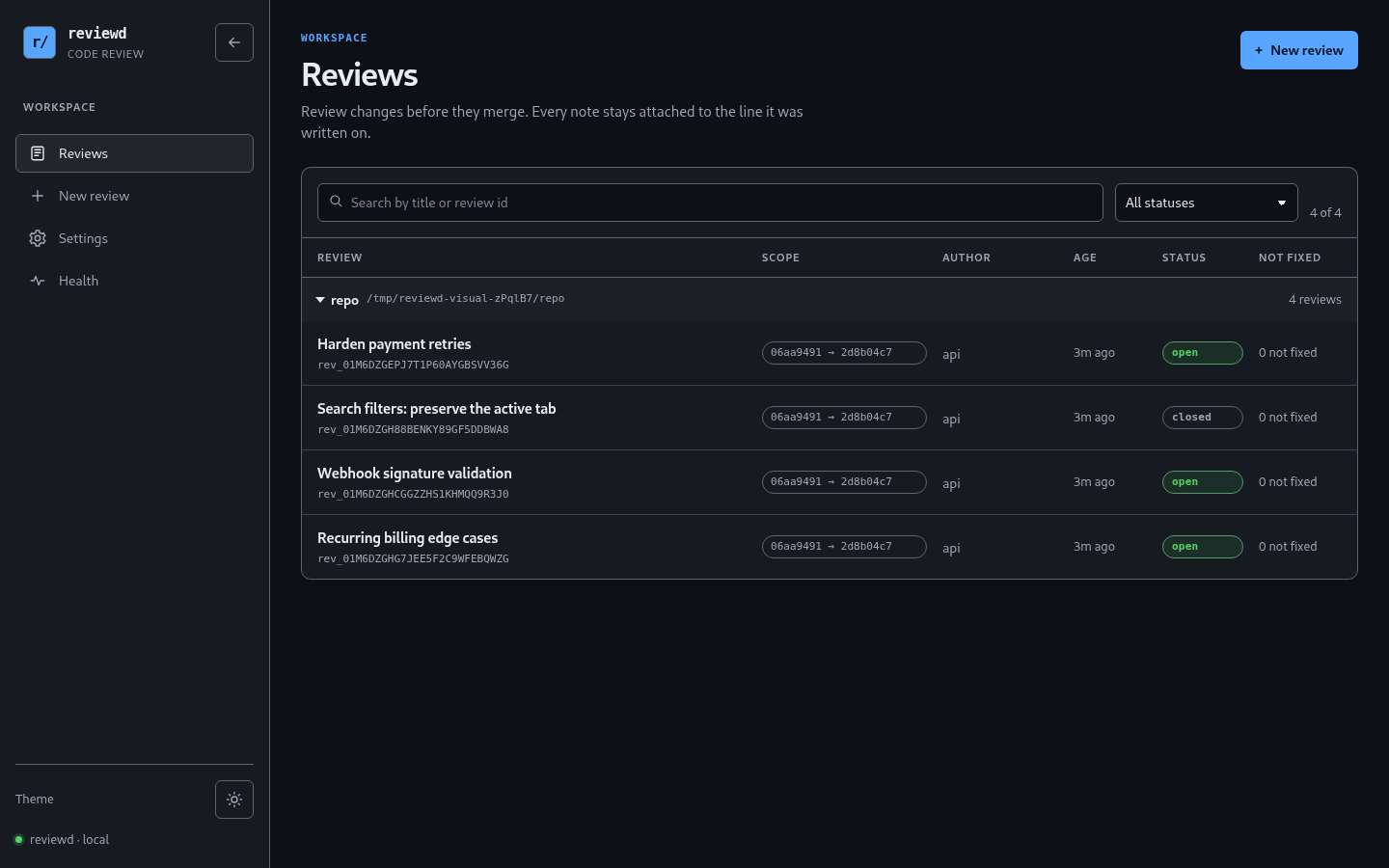
Reviews are grouped by repository and show status, rounds, open comments and the count that still needs attention. Search and filters work on the same list a human actually uses.
2. The diff is the workspace
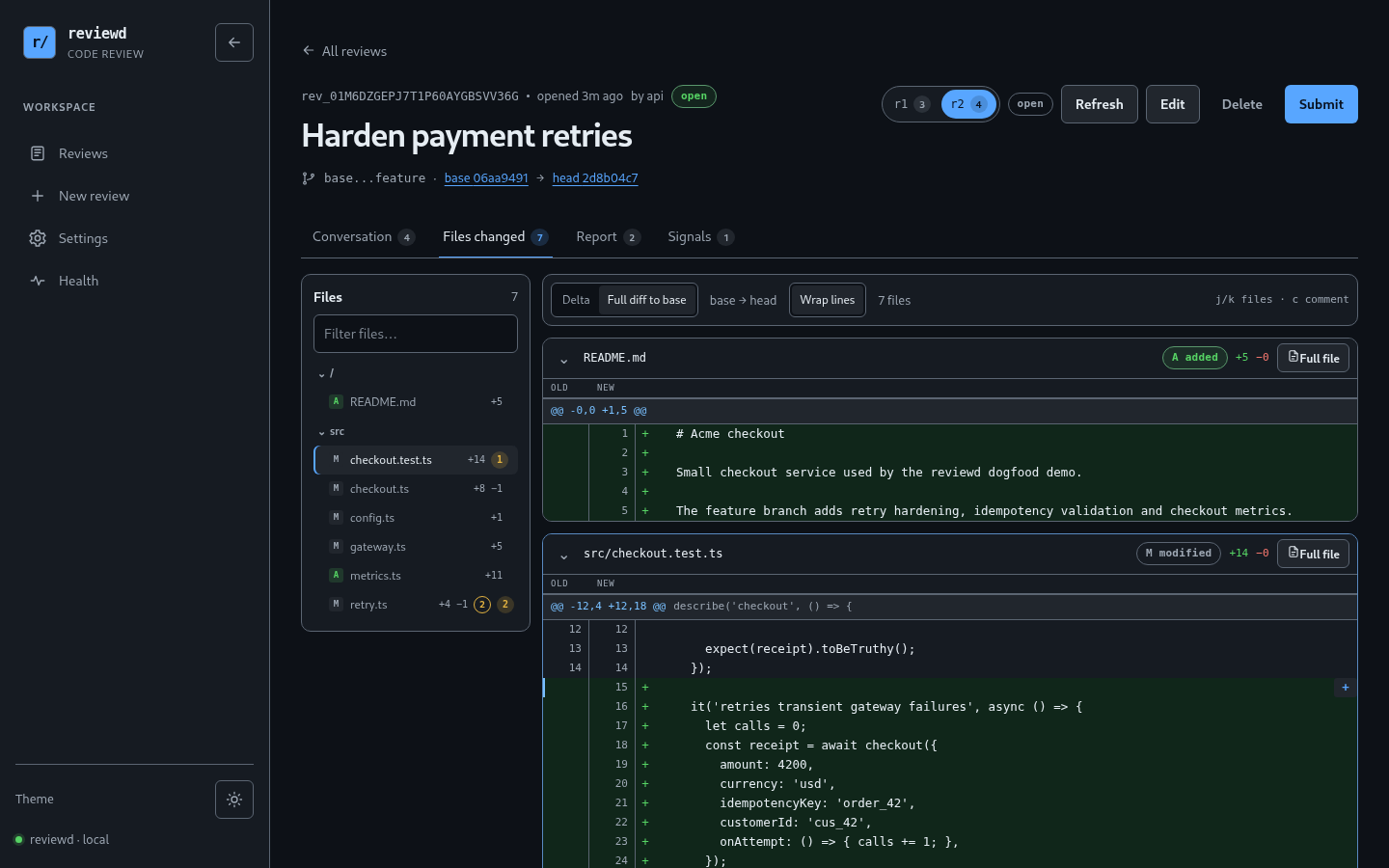
Delta and full views, a file tree with change counts, inline suggestions and comment or finding badges. Every thread keeps its file, side and line — including lines outside the hunk.
3. An independent pre-review
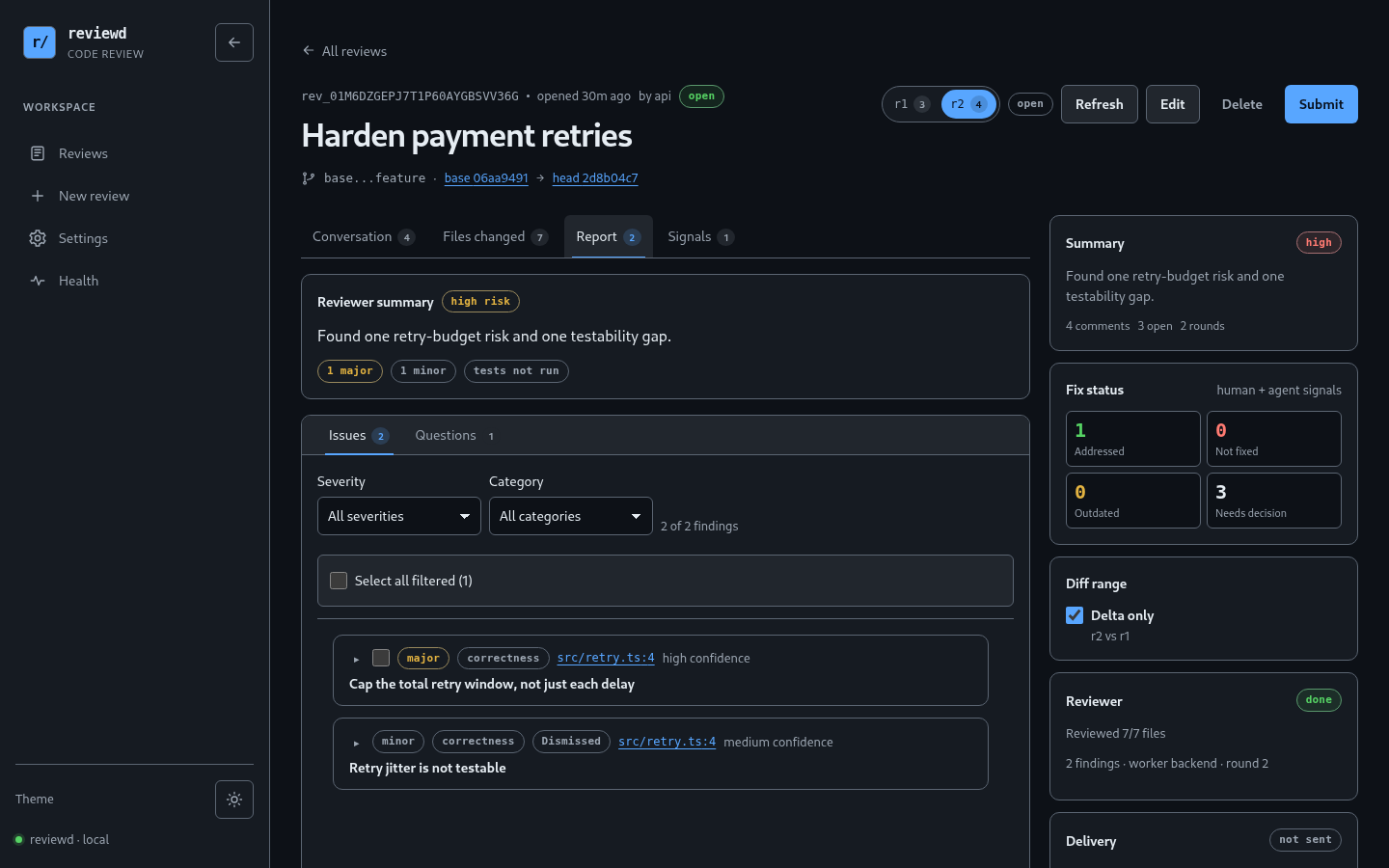
A reviewer worker posts structured findings with severity, evidence, questions and optional suggestions. A human accepts or dismisses each one with a note; accepted work stays actionable for the next agent.
4. Submit is a handoff, not a comment
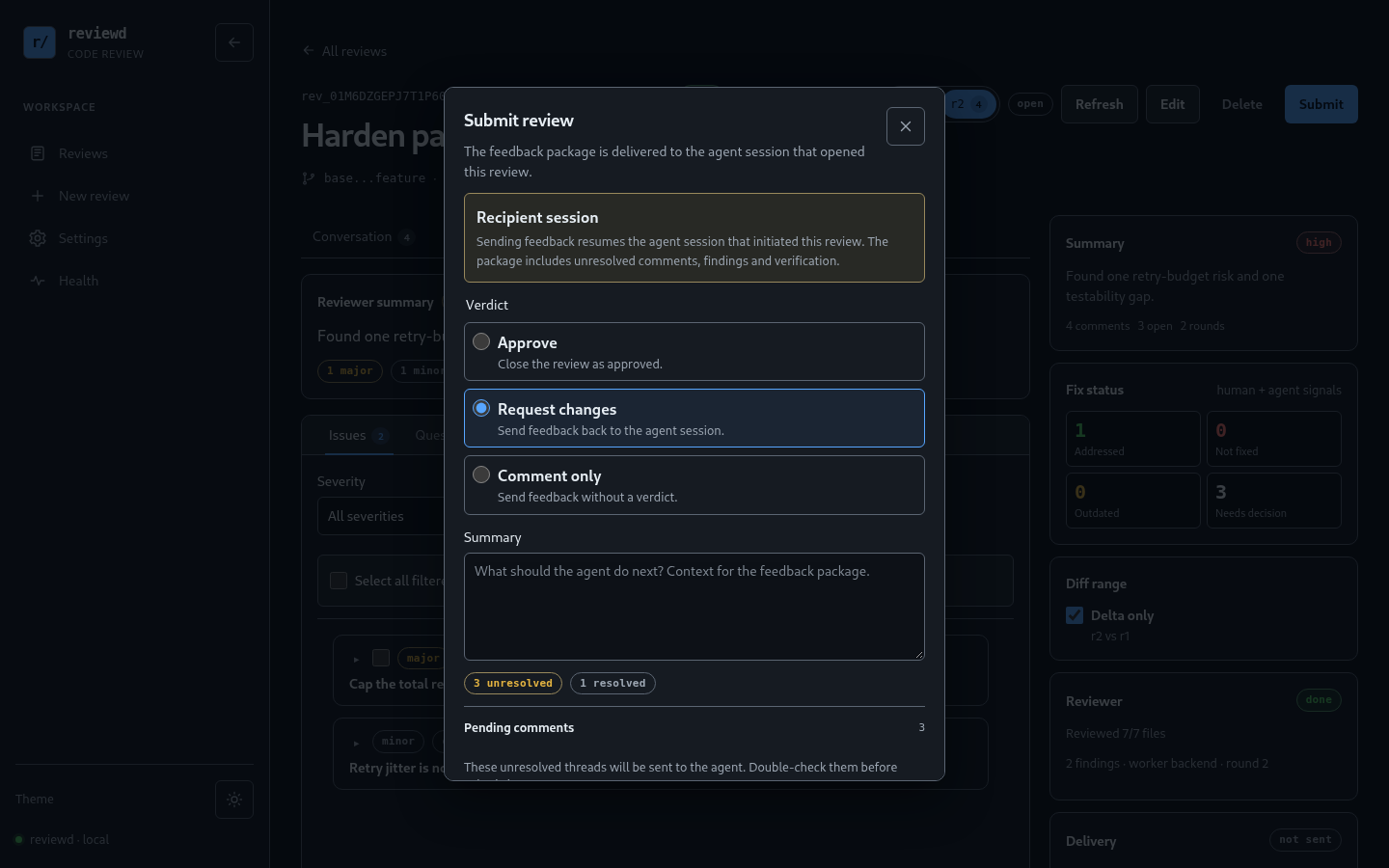
Submitting produces a deterministic feedback package: unresolved comments, accepted findings, dismissed reasons, suggestions, questions and verification. It is delivered to the initiating DSH session or read by CLI/HTTP clients.
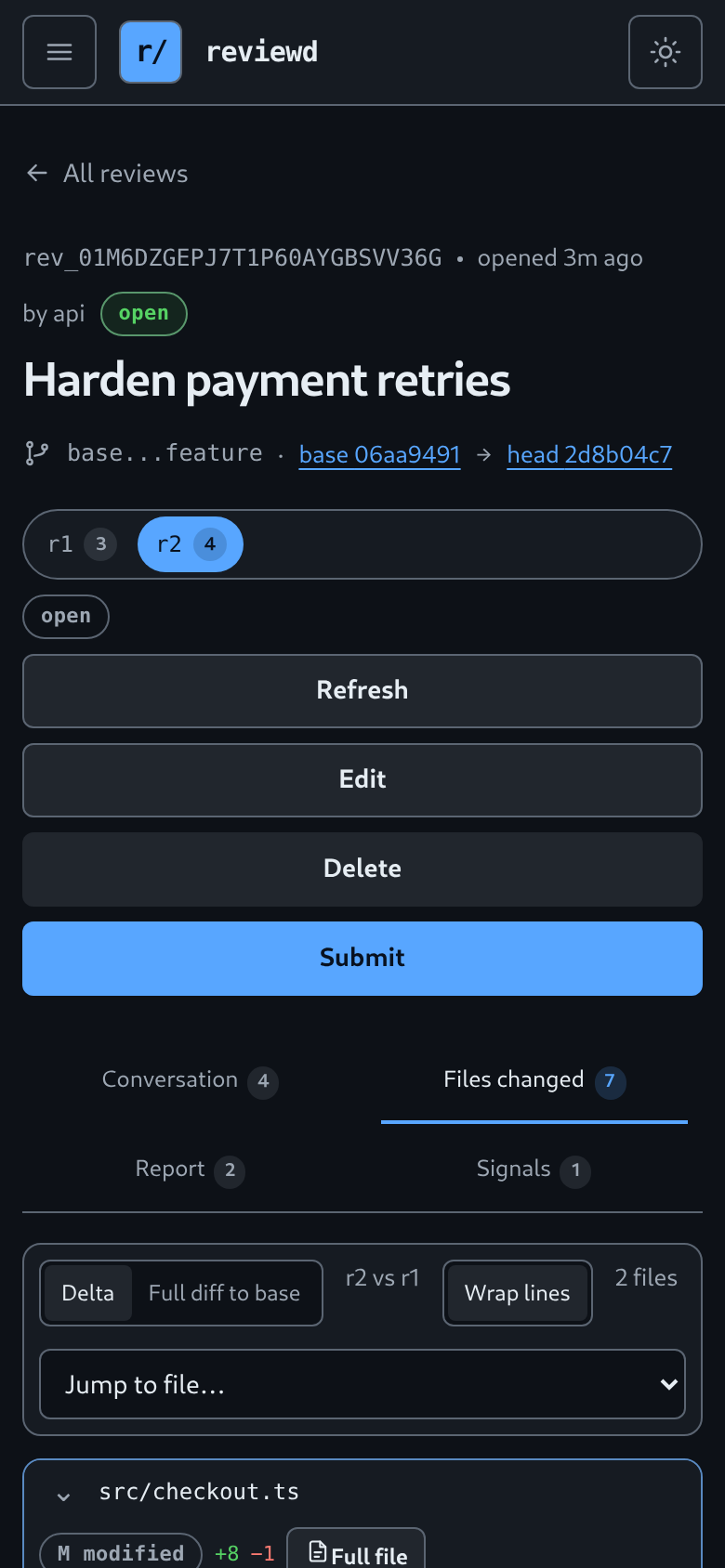
The same review surface down to 320px, with keyboard navigation and light/dark themes.
The same review survives a force-push: comments are re-anchored across renames and moved
hunks, old and new locations are visible, and outcomes are explicit (applied, addressed,
unchanged, outdated, moved). Nothing is silently rewritten.
What stays true
- Independent pre-review. A read-only reviewer reads the diff, manifest and surrounding code, then posts findings as events — never as an unstructured chat log.
- Review that survives the change. Immutable rounds, quoted context, content hashes and deterministic re-anchoring keep the conversation attached to the code.
- A real handoff. The feedback package has a stable key and no timestamps or random values, so repeated reads and deliveries are idempotent.
- Self-hosted state. Append-only
events.jsonlper review, local store, one token, no hosted service. The UI, CLI, DSH bundle and workers are adapters over the same service.
Quick start
Docker (recommended)
Requires Docker 26+ with Compose v2. The stack binds 127.0.0.1:3100 by default.
TOKEN="$(openssl rand -hex 32)"
CODE_REVIEW_TOKEN="$TOKEN" CODE_REVIEW_PUBLIC_URL=http://127.0.0.1:3100 \
  docker compose up -d --build
docker compose ps
curl -fsS http://127.0.0.1:3100/api/health
Open http://127.0.0.1:3100, sign in with $TOKEN, and create a review. Keep the token
across restarts by copying .env.example to .env; .env is gitignored.
The image only sees repositories you mount. See Deploy reviewd for repository mounts, TLS, token rotation, backups, retention and upgrades. Do not expose port 3100 directly to the public internet: there is one shared token and no account system.
Local (Node 22)
pnpm install
pnpm build
export CODE_REVIEW_TOKEN="$(openssl rand -hex 32)"
export CODE_REVIEW_STORE=/tmp/code-review-store
node packages/server/dist/reviewd.js
# http://127.0.0.1:3100
Need a disposable repository and a ready-made review? Run scripts/demo.sh; it starts a
daemon on a random port, creates a base..feature review and prints the URL.
DSH
dsh plugin --profile web add @sir_yami/reviewd
Restart the profile so Host routes and loops load. Embedded mode is the default: the bundle
starts reviewd in-process and serves the review UI at /code-review behind DSH session
auth. See DSH integration for configuration, tools, worker and data
retention.
Release status: the
0.2.0npm release is live under@sir_yami: DSH bundle, core, server and CLI. Docker and source checkouts remain available.
CLI
Install the published CLI:
npm install -g @sir_yami/reviewd-server
review version
The package exposes review and reviewd. From a source checkout, build and run
node packages/server/dist/cli.js.
review start --repo /srv/repo --base main --reviewer worker --json
review status <id> --json
review comments add <id> --file src/a.ts --line 42 --body 'Please explain'
review feedback <id> --wait --format md
review submit <id> --request-changes --summary 'Address the blocker'
review refresh <id>
review health
Remote commands use CODE_REVIEW_URL (or --daemon) and CODE_REVIEW_TOKEN. review diff
is local and needs no daemon. See the CLI reference for the full
command surface and exit codes.
Documentation
| I want to… | Start here |
|---|---|
| See the full feature tour | Features |
| Install and create my first review | Quick start |
| Review a change as a human | Review a change |
| Run a fix agent against review feedback | Run a fix agent |
| Connect DSH, Claude Code, Codex, pi or HTTP | Connect an agent |
| Deploy and operate reviewd | Deploy |
| Look up commands or HTTP routes | CLI · HTTP API |
| Understand the internals | Architecture · Review state |
| Work on the code | CONTRIBUTING.md |
The complete documentation index is docs/README.md. Agents that use reviewd should start at AGENTS.md; a machine-readable index is at llms.txt.
How it works
flowchart LR
  Agent[Coding agent] -->|start review| Daemon[reviewd]
  Daemon --> Reviewer[Independent reviewer]
  Reviewer -->|findings| Daemon
  Daemon --> UI[Human review UI]
  UI -->|comments, decisions, submit| Daemon
  Daemon -->|deterministic feedback| Agent
  Agent -->|fix, refresh, resolve| Daemon
The daemon owns the review lifecycle; the UI, CLI, DSH bundle and workers are adapters over the same service. See Architecture for components and data flow.
Security model
- One shared bearer token (
CODE_REVIEW_TOKEN, 32+ bytes), required at startup and never logged or baked into the image. Browsers exchange it for an HttpOnly, SameSite=Strict cookie; machine clients useAuthorization: Bearer. - Health and version are public; all review data is authenticated. Mutations reject cross-origin requests; there is no CORS. Rate limits and body/diff/snapshot caps bound resource use.
reviewdis plain HTTP. Terminate TLS at a reverse proxy and keep the listener on loopback or a private network. There are no per-user accounts or token revocation lists.- Reviewer output and comments are untrusted data. Rendering is safe text/code; reviewer tools use a read-only allowlist; command backends run without a shell, with a minimal environment and bounded output.
See SECURITY.md for the full threat model and reporting process.
Status and limitations
- 0.2.0 release. API/schema version 1; no automatic event-schema migrations.
- Single-tenant by design: one token, no accounts, no hosted control plane.
- No bundled model or agent CLI; bring a DSH worker, command backend or your own reviewer.
- Native adapters exist for DSH only. Claude Code, Codex, pi and other harnesses use the CLI/HTTP contract; MCP is not shipped.
- The event store is a single-writer local filesystem store; there is no HA/clustering.
- The image is Linux/amd64-oriented; multi-arch manifests are not published.
- npm packages are published under
@sir_yami/*: DSH bundle, core, server and CLI0.2.0.
No comments yet. Be the first to write one.