dsh-sidebar-git-graph


A right-sidebar page for DSH (DeepSeek Harness) that draws the current session's repository as a branches-and-merges commit graph — VS Code style: colored lanes, bezier curves where branches split and merge, ref chips, per-commit details — with a working-tree Changes area above it.
Read-only. It never runs checkout, commit, reset, rebase, fetch, push,
add or restore. The only git commands it runs are rev-parse, status,
for-each-ref, log and diff.
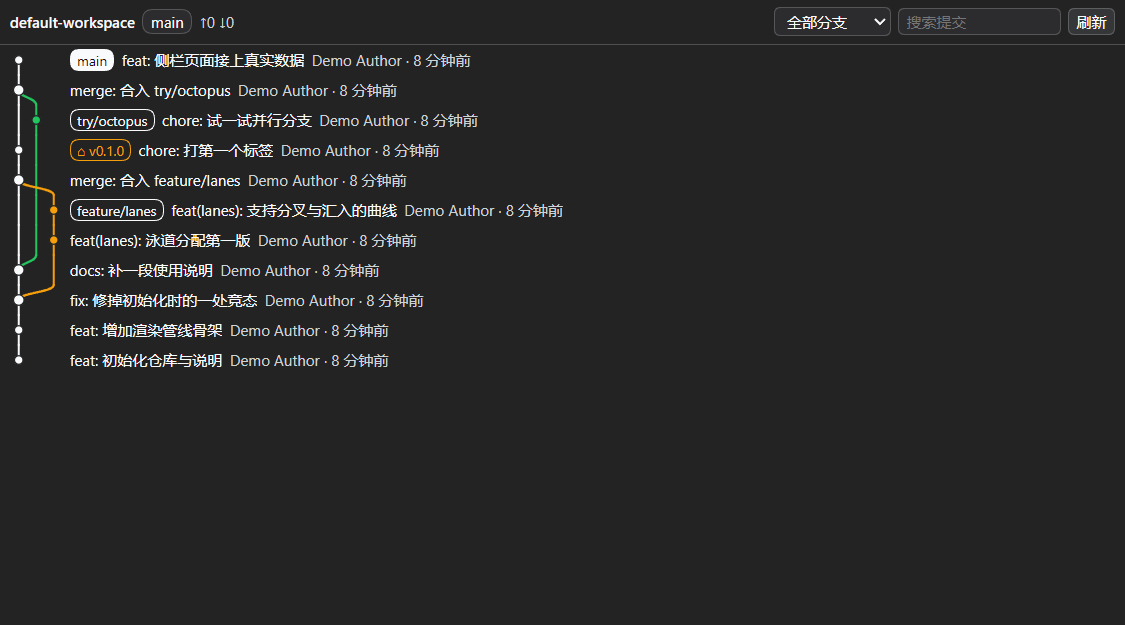
The screenshot above predates the Changes area and shows the commit graph alone.
Features
- Working-tree changes, VS Code style — a Changes and a Staged Changes section above
the graph (plus Merge Changes during a merge), each row carrying its status letter
(
M/A/D/R/C/U) and its added/deleted line counts. Click a file to expand its diff inline; the sections fold and remember it. - Branch/merge relationships at a glance — one lane per concurrent line of history, curved connectors where a branch forks or merges back, thicker dots on merge commits, and the HEAD lane emphasized.
- Ref chips per commit — local branch / remote branch / tag, with the current branch filled in the theme's brand color and the theme's matching on-brand foreground.
- One workspace, several repositories — a workspace often holds more than one repository (this
project's own checkout has a nested one under
vendor/@zeng/). The header then grows a picker listing every repository it found; the choice is remembered per workspace. A workspace that is itself only a subdirectory of a repository works too — the enclosing repository is offered as well. Discovery never leaves the workspace: it scans downwards, bounded by depth, directory count, repository count and a time budget. - Header at a glance — repository name, current branch,
↑ahead ↓behind, dirty-file count. - Commit search — highlights matches and steps through them (the graph stays intact; it never re-lays-out a filtered list).
- Details on click — full sha, author + email, absolute time, parents, participating refs.
- Virtualized list — a 2000-commit window still renders only the visible rows; nothing is requested while the page is not the visible tab.
- Honest error states — not a git repository / no
gitonPATH/ no workspace / trust fence refused / git failed each get their own message instead of a blank page. - Zero dependencies, no build step — the host half is plain ESM, the browser half is a
single hand-written client-bundle file. What you read in
lib/is what runs.
Install
dsh plugin --profile web add github:AFunDog/dsh-sidebar-git-graph
Then restart dsh web (the host half adds a route) and hard-refresh the browser. Open the right
sidebar and pick Git graph — from the + menu when dsh-better-sidebar is installed, or from
the sidebar's guide page on a bare DSH (the + control is not drawn while that pane already
holds the guide tab). The page follows the session you are viewing:
switch sessions and it re-reads that session's workspace.
# pin a tag (recommended: lockfiles record the resolved commit)
dsh plugin --profile web add github:AFunDog/dsh-sidebar-git-graph#v0.2.0

# from a local clone (absolute path only — relative paths are rejected by spec parsing)
dsh plugin --profile web add /path/to/dsh-sidebar-git-graph
With or without dsh-better-sidebar
The page works both ways, and picks automatically:
| Your setup | What happens |
|---|---|
| dsh-better-sidebar installed | The page registers through its public ctx.betterSidebar.registerTab service: it shows up in the + menu, gets a card in Settings → Side cards (with an on/off switch and a per-plugin setting for the commit window), and appears under Git graph. |
| Bare DSH | The page registers with DSH's own sidebar tab type (ctx.sidebarRightTabs + the sidebar.right.pane.tab slot) — same column, same + menu, minus the settings card. |
The service contract is re-stated locally (only registerTab / openTab are used) and is
activated with ctx.inject, never a static inject: a statically declared service that is
absent would park this plugin's fiber, which shows up as "works after a hot reload, gone after
a restart".
How it works
lib/index.js      host half  — POST /dsh-sidebar-git-graph/api, git execution, trust fence
lib/git-read.js   host half  — pure: argv builders + parsers (importable by plain node)
lib/changes.js    host half  — pure: working-tree argv builders + parsers
lib/repos.js      host half  — "how many repositories are in this workspace" discovery
lib/workspace.js  host half  — sessionId → working directory, workspace allow-list, fence
lib/client.js     browser half — tab registration, lane layout, SVG rendering (single file)
test/             zero-dependency tests (node scripts/test.mjs runs them all)
The route dispatches on the request envelope's method: graph (commit DAG), changes
(working-tree status) and diff (one file's patch).
- The browser half reads the session's working directory and asks the host for a snapshot.
- The host resolves which workspace belongs to that session (session service → persisted
workspace table → workspace registry → newest session directory), refuses paths that are
neither registered nor the session's own cwd, then picks the repository to draw: the one the
browser named (if it passes the fence and
rev-parseagrees it is a repository root), else the one containing the workspace, else the first one it finds inside the workspace. It runs the four read-only commands with a sanitized environment, a 10 s timeout and a 48 MiB output cap, and answers with{ repo, repos[], selection, refs, commits[{ sha, parents, author, email, time, subject, refs }] }. - The browser half lays the commits out into lanes with one pass over
--topo-orderhistory and renders SVG bezier connectors under a virtualized row list.
The layout function and the geometry builder are pure and exposed on the plugin's internals
so the test suite can drive them without a browser.
Settings
| Setting | Where | Default | Meaning |
|---|---|---|---|
| Commits loaded per read | Settings → Side cards → Git graph → feature settings (dsh-better-sidebar only) | 400 |
100–2000. Bigger is more complete and slower on first read. |
| Repository scan depth | same place | 5 |
0–8. How deep to look for repositories to offer in the picker; 0 means "no scan — only the repository the working directory is in". Lower it if a huge workspace reports an incomplete list. |
| History scope | page header | all branches | All branches or current branch only. |
| Commit search | page header | — | Highlights matches and steps through them. |
Limitations
- Read-only by design. No staging, no commit, no checkout, no push. To change the working tree, use another tool.
- Untracked files carry no
+/−counts.git diff --no-indexcompares exactly two paths, so per-file counts would mean one process per file — hundreds of them in a repository that has not beenadded yet. The section header counts what it can and leaves the rest blank rather than printing a0that would read as "nothing changed". A file changed on both sides shows up in both sections, which is what the two sections are for. - A nested repository is one non-clickable row.
gitdoes not descend into a repository inside a repository (even with-uall), so the outer repository sees a single directory and there is no diff to show for it. The page says so on the row instead of doing nothing when clicked. - At most 3000 rows, and at most 512 KiB of patch per file; both are reported in the page rather than silently cut.
- The window is bounded (up to 2000 commits per read, default 400); older history is reported as truncated rather than silently dropped.
- Repository discovery is bounded, and it scans the filesystem. Depth, directory count,
repository count and elapsed time are all capped; hitting a cap is reported in the page instead
of being hidden, and lowering the scan depth is the fix. Directories that never hold repositories
of interest (
node_modules,target,.venv, build output, …) are not descended into — though each of them is still stat'd once, so a repository that happens to be namedbuildis still found. - The picker only offers what is reachable from the workspace — the workspace itself, something
inside it, or the repository that encloses it. The host refuses any other path even if the
browser asks for it, and re-checks with
rev-parsethat the path really is a repository root. - Search does not filter the graph — filtering would break lane continuity, which is the whole point of the page; matches are highlighted and stepped through instead.
- Lane colors are derived from DSH theme tokens with
color-mix(). On a browser withoutcolor-mix(), lanes fall back to the four theme state colors in rotation. - Persisted DSH internals are a fallback only — reading
storages/workspace.jsonandsessions/is the last resort when the session/workspace services are unavailable. - Verified on DSH
0.1.7-rc.2withdsh-better-sidebar0.21.1; the native fallback path is covered by the same tests but has had less real-world use. - The npm name
dsh-git-graphbelongs to a different plugin by another author (enoughpower/dsh-git-graph). This one is@zeng/dsh-sidebar-git-graphand is currently distributed from GitHub only.
Development
No build step: edit lib/, restart dsh web for host-half changes, hard-refresh for browser-half
changes (a changed client bundle is picked up with a reload — its rev is re-derived from the
file's mtime).
npm test # = node scripts/test.mjs: node --check on every lib file, then every test
git must be on PATH for the route test. scripts/test.mjs discovers test/*.test.cjs, so a
new test file cannot be forgotten in CI (listing files in the workflow once already meant three
new tests ran nowhere).
Colour tokens are the one place where a typo fails silently: var(--typo, fallback) just falls
back, so a wrong name shows up as "the colours look wrong" rather than as an error. This plugin
shipped exactly that bug once — the current-branch chip used --dsw-alias-label-inverse, which
does not exist, so its text inherited the theme's body colour while its background was
--dsw-alias-brand-primary. In the light theme those two resolve to the same value: the chip
was 1.00:1 contrast in both themes (white on white in dark mode). The fix is
--dsw-alias-label-primary-foreground, the token DSH itself pairs with button-primary-fill
(= brand-primary): 18.9:1 and 18.1:1.
test/style-tokens.test.cjs has a built-in snapshot of every --dsw-alias-* token and fails if
the CSS references anything outside it. To re-check that snapshot against the real theme:
ZGG_THEME_FILE=<dsh>/node_modules/@deepseek-ai/dsh-client-ui-theme/lib/client.js \
  node test/style-tokens.test.cjs
Notes for implementers
Traps that cost real time here, in the order they bite:
String.split(sep, limit)discards the remainder — it does not fold it into the last element.'a file with spaces.txt'.split(' ', 11)[10]is'a'. Every porcelain v2 record ends with a path that may contain spaces, so indexing by field number truncates it silently. Split the fixed fields off and join the rest back.- The
u(unmerged) record is not shaped like1or2— it has 11 fields (u <XY> <sub> <m1> <m2> <m3> <mW> <h1> <h2> <h3> <path>). Parsing it as a 9-field1record drops conflict files entirely, which is silent data loss that only appears during an actual merge. Produce a real conflict and dump the bytes instead of trusting the docs. git diff --no-indexexits 1 when the files differ, and stderr is empty in that case. Without special-casing it, untracked files can never open a diff and there is no error message to explain why.- Pass both paths for a rename. With only the new path,
-Mdoes not detect the rename and you get "new file mode" plus the whole file as additions (measured: 1 added line became 41). - Do not inspect
-zoutput through a PowerShell pipeline. PowerShell splits on newlines and stringifies;-zoutput has no newlines, so the whole thing collapses into one element and the NUL boundaries become easy to misread. Use Node withencoding: 'buffer'and split on NUL. --literal-pathspecsis mandatory. Without it a browser-suppliedpathis parsed as pathspec syntax, and a value like:(top)*widens "read one file" into "read the whole tree".- Nested repositories have no diff.
gitdoes not descend into a repository inside a repository, even with-uall, so the outer repository reports one directory row and--no-indexon it fails withCould not access '<dir>/null'. git diffon an unmerged path emits a combined diff —@@@hunk headers with two-character prefixes (++,+,+). A unified-diff reader cannot parse it and will return zero lines, i.e. an empty diff with no error. Compare such paths againstHEADinstead; that is a normal unified diff and shows the file exactly as it is on disk.- A conflicted file and an untracked file share the status letter
U— so the client must not decide "use--no-index" from the letter. Getting it wrong renders the whole file as additions, again with no error. The host statesuntrackedexplicitly per row. methodis not part of the old contract. Before this release the host ignored it and always answered with commit-graph data. Because the browser half reloads on every page load while the host half needs a restart, an older host is a normal state to be in — so validate the response shape, or you will render "no changes" from a payload that never mentioned any.- Do not sanitize the git environment by disabling system config. Setting
GIT_CONFIG_NOSYSTEM=1also dropscore.autocrlf, which Git for Windows sets in its system config. A repository with LF in the index and CRLF in the working tree then reports every line as changed —+1 −0became+88 −87, a one-line addition drawn as a whole-file rewrite. SettingGIT_CONFIG_SYSTEMto an empty string does the same thing (measured), so "redirect it instead" is not a safe variant either. Set neither and let git find its own config; whitelist the environment to keep credentials out. Verify by diffing your counts againstgit diff --numstaton the same tree.
License
MIT — see LICENSE.
No comments yet. Be the first to write one.