dsh-token-usage
Live and historical token usage for every session in DeepSeek Harness — on one dedicated page.
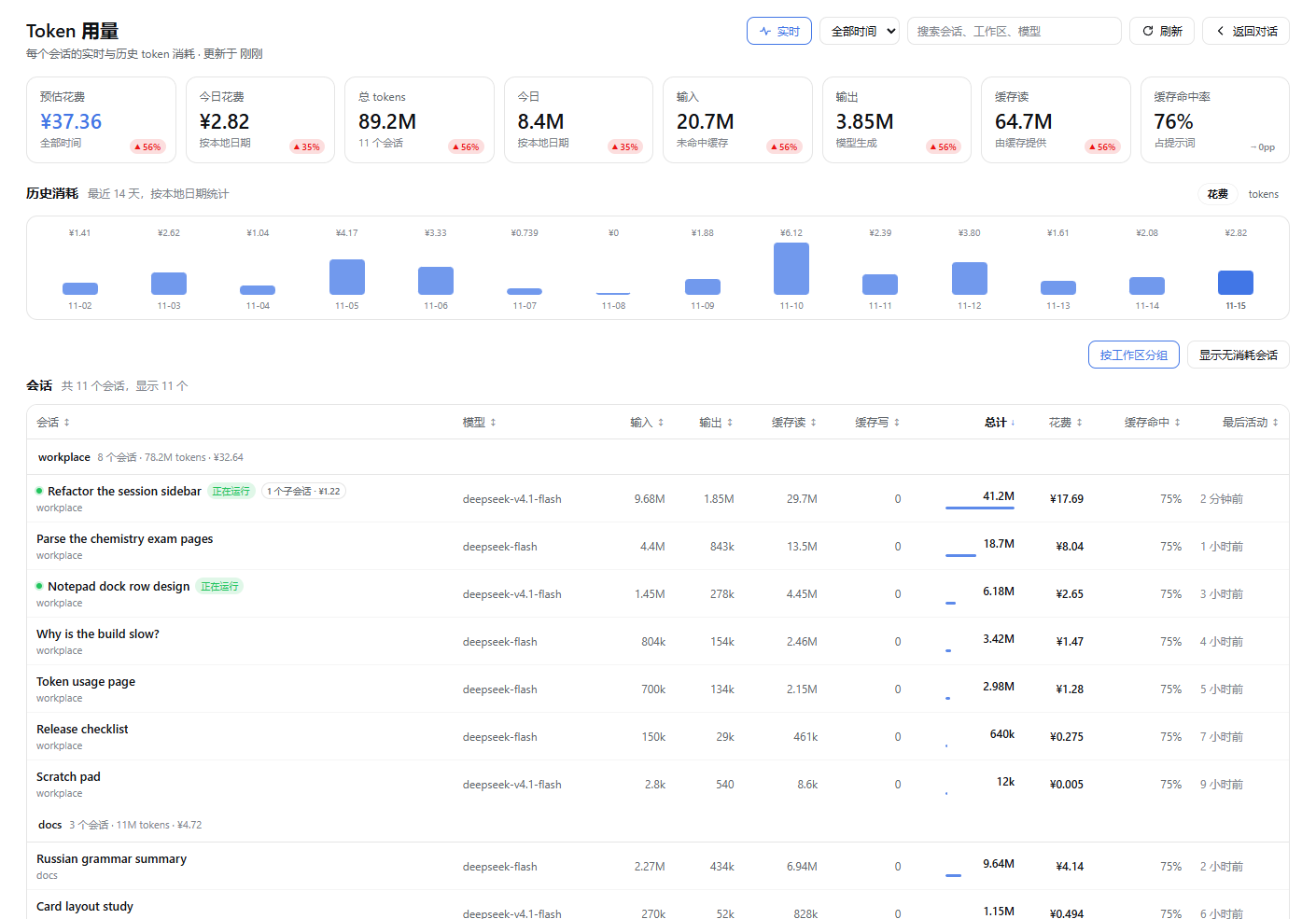
What it does
- A real page, not an overlay. The plugin registers a global panel in the centre column, the same mechanism the Plugins page uses: opening it replaces the Conversation in the main slot instead of floating above it. Enter from the Token usage row in the sidebar and leave with Back to chat (or by opening any session).
- Live. Every durable session artifact is scanned incrementally — only the Zstandard frames appended since the previous poll are decoded. The page polls a same-origin route every two seconds and marks sessions that are still running with a green dot and a “running now” badge.
- History. A strip charts the last 14 local calendar days; every session also keeps its own per-day buckets.
- Sorting. Click any header to toggle ascending / descending: session, model, input, output, cache read, cache write, total, spend, cache hit rate, last active. Search filters by session, workspace, model, or id; sessions without usage stay hidden until you ask for them.
- Time windows. The header selector switches the summary and the table between today / last 7 days / last 30 days / all time, recomputed from each session's own day buckets.
- Trend badges. Every summary card carries a small pill in its bottom-right
corner —
▲56%or▼12%— green when the change is good, red when it is not (more spend or tokens is red, a higher cache hit rate is green, flat is→0pp). Hovering shows both values: a selected window compares with the window before it, all time compares the latest 7 days with the 7 before, and the two “today” cards compare with yesterday. - Workspace grouping and sub-sessions. Rows group under their workspace with
a subtotal; a subagent session folds into its parent as a chip
(
1 sub-sessions · ¥1.22) that expands inline. Grouping can be turned off. - Warm start. The fold is cached in
~/.dsh/token-usage-cache.jsonkeyed by artifact size and modification time, so a restart reads no session logs at all (2.3 s cold → ~7 ms warm). Any changed file falls back to an incremental read. - Numbers that mean something. Usage is folded exactly like the shipped
tokenUsageprojection: a final assistant settlement replaces the streaming sample of the same attempt, and a retried attempt is billed separately. - Estimated spend. Every attempt is priced at the moment it happened, so the
peak/off-peak window and the model of that request are honored: the built-in
table uses DeepSeek's official CNY list prices (Flash
0.02 / 1 / 4, Pro0.15 / 4.5 / 13.5per million cache-hit / miss / output tokens) with the Beijing peak window doubling every rate. Spend appears in the summary strip, as a sortable table column, and as the default history metric.
Configuration
None.
Overriding prices
The estimate is a reference figure, not a bill. Override the table by creating
~/.dsh/token-usage-prices.json:
{
  "currency": "CNY",
  "symbol": "¥",
  "peakMultiplier": 2,
  "models": [
    { "match": "minimax", "cacheHit": 0.3, "cacheMiss": 3, "output": 9 },
    { "match": "deepseek-v4-pro", "cacheHit": 0.15, "cacheMiss": 4.5, "output": 13.5 }
  ],
  "fallback": { "cacheHit": 0.02, "cacheMiss": 1, "output": 4 },
  "holidays": ["2026-10-01", "2026-10-02"]
}
Rates are per million tokens in currency; match is a case-insensitive
substring of the provider model name, longest match first. Every field is
optional — omitted fields keep their built-in value. holidays are the days
that bill at the off-peak rate all day; add each new year's statutory holidays
there.
Implementation
| File | Role |
|---|---|
index.js |
Host half: incremental Zstandard frame reader over ~/.dsh/sessions, the usage fold, and the read-only /token-usage route. |
client.js |
Browser half: the global panel, summary strip, 14-day history strip, sortable table, and polling. |
The Host half registers no tool and adds no prompt content; it serves one read-only JSON route. Artifacts are decoded frame by frame, so a poll only reads what the Host appended since the previous one; restarts, truncation, and a half-written final frame each have their own handling.
- What it does not do. The estimate prices uncached, cache-write, and cache-read prompt tokens from usage the provider reported; it does not read account balances, and it does not know a provider's private rates unless you override them.
Development
node test/host.test.mjs          # host fold, incremental reader, pricing (no third-party deps)
pnpm add -D jsdom react react-dom
node test/page.dom.test.mjs      # runs the shipped client.js in jsdom: sorting, search, states
License
MIT.
No comments yet. Be the first to write one.