dsh-control
English | 中文
Every machine already runs dsh. Make this one window the front end for all of them.
Chat with the dsh instances on your other machines, natively from your local sidebar. Remote sessions stream back token by token; the remote uses its own model credentials, tools and sandbox. Zero changes on the remote. Zero dependencies. One-line install.
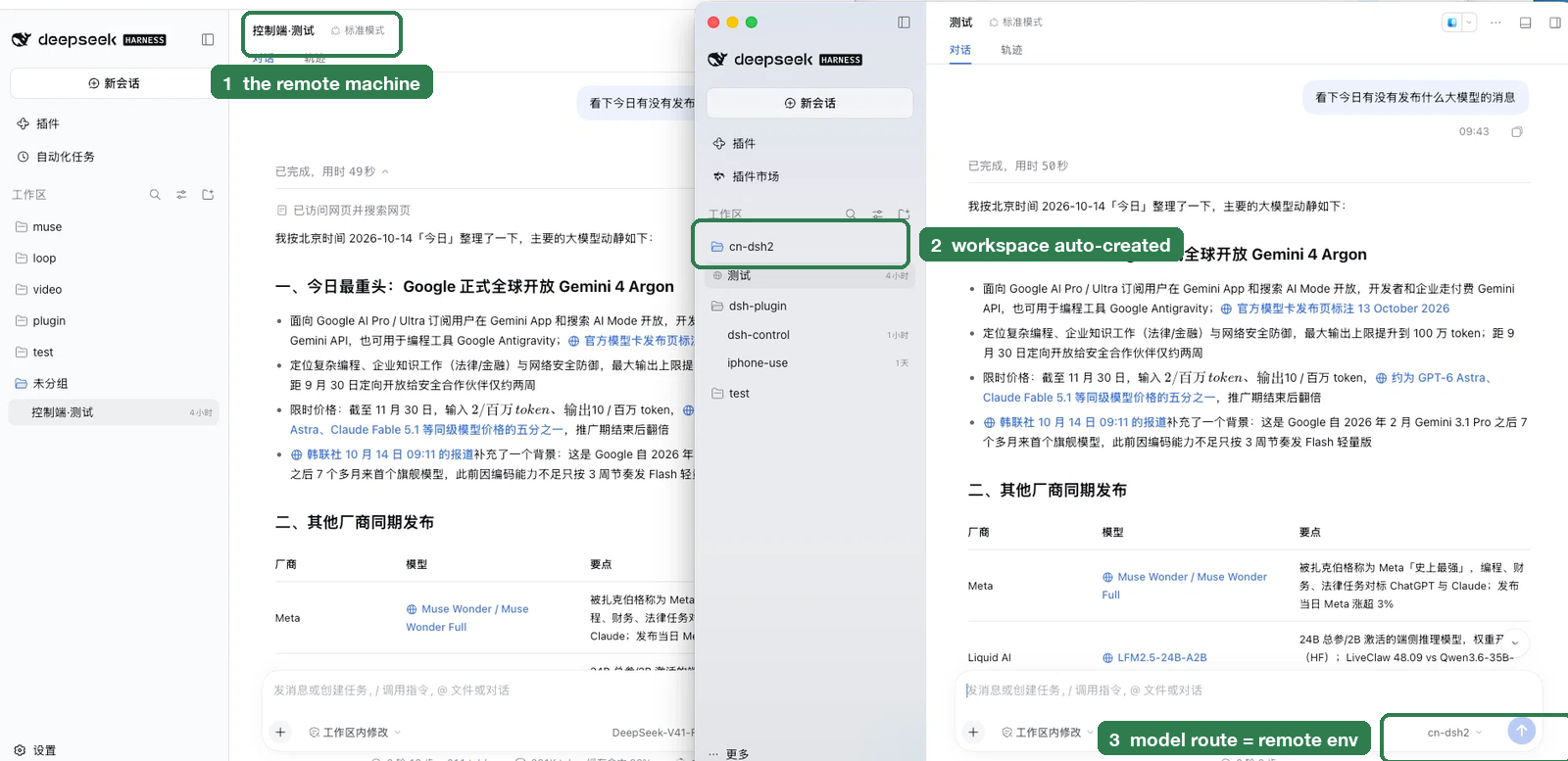
Two dsh windows answering the same question. The left window shows a session auto-named
控制端·<local title> (①) — that naming only happens on the machine the plugin drives. The right
window shows the workspace cn-dsh2 the plugin created (②) and the model route set to the
environment name (③).
🎬 A 15-second capture (one-click connect → streaming reply) is being recorded.
Install
dsh plugin --profile <your profile> add github:6mt/dsh-control
Use the profile you already run (usually web or desktop). No build step, no native
modules, no dependencies — the plugin is plain JavaScript and installs as-is.
Download dsh-control-0.1.1.tgz and run:
dsh plugin --profile <your profile> add ./dsh-control-0.1.1.tgz
After installing, fully quit and reopen dsh (⌘Q). A「远程 dsh 环境」panel appears in the right sidebar.
An npm package (
dsh-control) is prepared and can be published later; the GitHub command above is the current install path.
Versions & updating
- What you get:
github:6mt/dsh-controlinstalls the newest commit ofmainand pins it in your profile's lockfile — it does not silently follow later commits. - Update:
dsh plugin --profile <your profile> update dsh-control(pnpm re-resolves the git ref and pulls the new code) - Pin a version:
github:6mt/dsh-control#v0.1.0(tag) orgithub:6mt/dsh-control#<commit> - Changes are recorded in CHANGELOG.md.
How is this different from dsh-remote / dsh-remote-ssh?
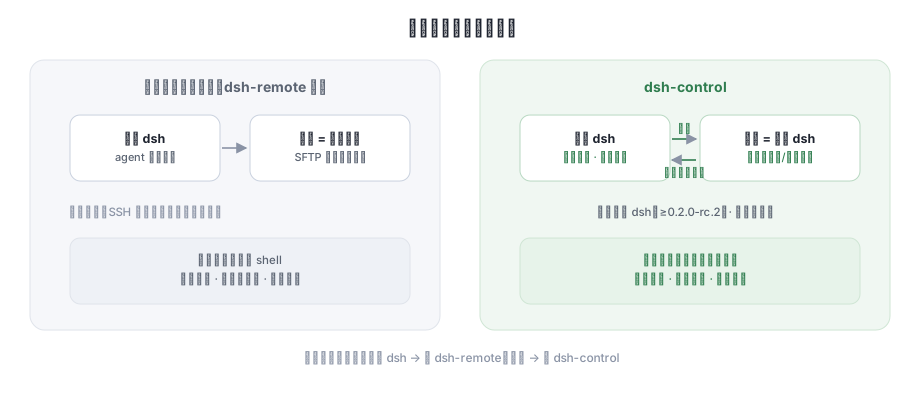
| Remote-workspace plugins (dsh-remote, …) | dsh-control | |
|---|---|---|
| The remote machine is a | file system (SFTP tool set) | dsh that is already running there |
| Sessions live | local session + remote directory | remote sessions, native in your sidebar |
| Credentials & tools | configured locally, SSH config duplicated | the remote's own — nothing copied |
| Remote needs | only SSH | dsh installed (≥0.2.0-rc.2) with its web instance running |
| Changes on the remote | some deploy dsh for you | zero (read-only probing + the remote's own API) |
The two coexist (tested side by side): no dsh on the remote → use dsh-remote; dsh already there → use dsh-control.
What it does
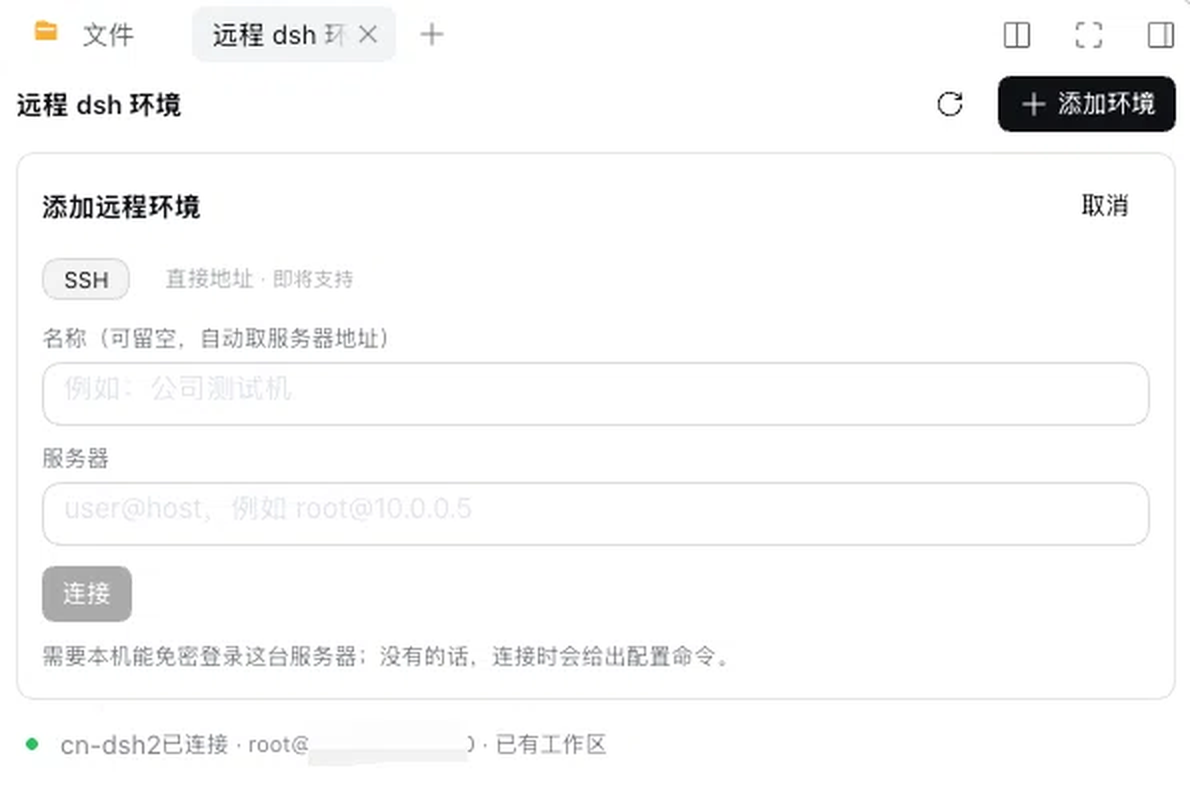
The「远程 dsh 环境」panel: type user@host and connect — the row then reports its state and
whether the environment already has its workspace.
- One-click connect — type
user@host; the plugin probes the remote dsh, fetches its access token and opens an encrypted channel (~5 s) - Automatic workspace — each environment gets a same-named local workspace; any session created inside it automatically becomes a remote session
- True streaming — remote replies flow in token by token, not dumped at the end
- Paired naming — remote sessions are named
控制端·<local title>, so both sides match - Visible & self-healing — remote sessions are marked in the sidebar; disconnects are reported honestly and repaired by one click
Security
What it does on your machine: one state file
($DSH_HOME/dsh-control/state.json, mode 0600, holds the remote access tokens) and an
on-demand SSH tunnel process.
What it never does: no installs or writes on the remote, no lifecycle management of
the remote dsh, never reads your other local credentials, tokens never enter logs.
When passwordless SSH is not set up it shows the exact one-line fix — passwords are
never stored. Details in SECURITY.md.
Known limitations
- The remote must already run dsh with its web instance (otherwise use a remote-workspace plugin)
- Connects over SSH (passwordless or configured key; a direct no-SSH mode is on the roadmap)
- Sidebar markers and the streaming feel are verified by eye per release
- Cancelling a remote turn is implemented but marked experimental
Development
node --check lib/*.js
for t in test/*.test.mjs; do node "$t"; done   # 52 checks: unit / contract / structural invariants
scripts/verify-boot-selfheal.sh                # boot self-heal (needs a local dsh runtime)
License
MIT © 6mt
No comments yet. Be the first to write one.