dsh-context-guard
npm package: @2jumpsina/dsh-context-guard · 中文
A DeepSeek Harness plugin that tells you to wrap up and start a new session before the session gets too long.
It consumes the contextPressure projection that the official dsh-token-meter has already computed, and after a turn has ended it speaks up on two thresholds: "write the handoff into a document first, then start a new session." It then helps turn that sentence into an action — once the threshold is crossed it drafts a handoff block into the session working directory.
Context tax = 0: it registers no model-facing tool, injects no prompt section, and sends no extra request. The host does the arithmetic, the UI does the talking.
⚠️ Do not run
npm i dsh-context-guard— that unscoped name is a third party's package (bygreenlv). This plugin's name is scoped:@2jumpsina/dsh-context-guard, published on npm (see Install).
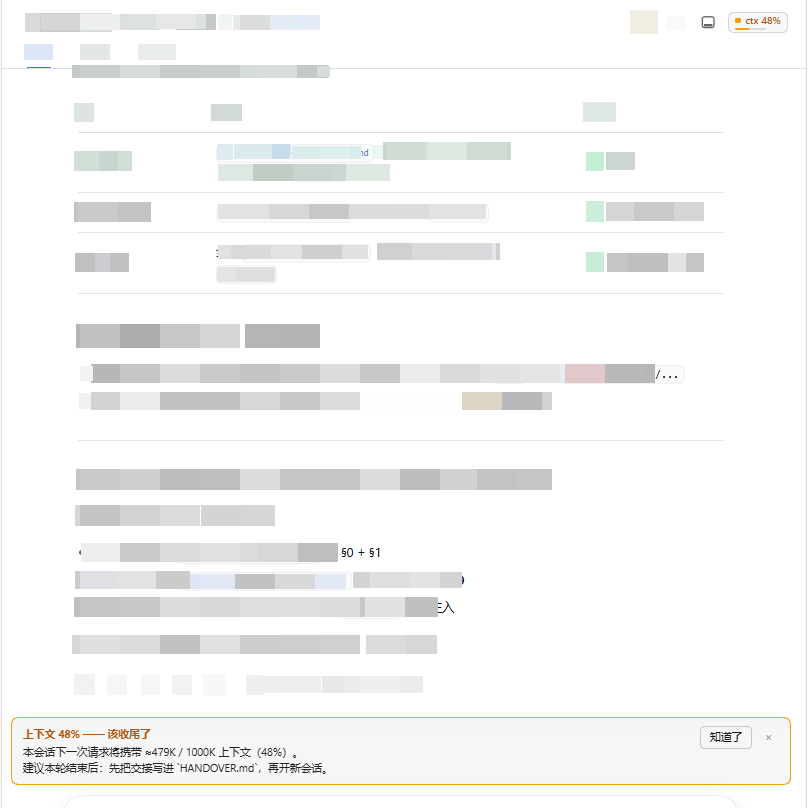
⚠️ It writes to your working directory (read this before installing)
- On by default (
handoverOnWarn: true). When a session's occupancy crosseswarnRatio(default 45%), the plugin creates/rewriteshandoverPath(defaultHANDOVER.md) in that session's working directory, and then refreshes it every further 5 percentage points. - What it writes are machine facts: session id, title, working directory, occupancy, turn/call counts, ledger cost, the files this session wrote, previews of the last few prompts and replies, plus empty "to be filled in" slots for the agent. ⇒ It may contain sensitive content (file paths, fragments of your questions and replies), and it may end up committed by git.
- Suggestions: add
HANDOVER.mdto your.gitignore; or pointhandoverPathat a location outside any repository; or simply sethandoverOnWarn: false. - Boundaries: a missing parent directory is refused; an existing target that is not a text file (
.json/.yml/…) is refused; a symlink pointing elsewhere is refused; writes are atomic (temp file + rename) with tight permissions (0o600). Any failure is recorded as status only — it never affects the badge, the banner, or the push.
Why this plugin has to exist
In one line: a long session is not a technical failure, it is a bill that grows every turn. This plugin exists to put that bill in front of you at the one moment you can still act on it — after a turn has ended and before the next request goes out.
The problem is measurable
Cost ≈ (average prompt size) × (number of calls) × (unit price). A long session pushes the first two factors up at the same time, and the unit price itself rises with occupancy. Measured against the ledger of the machine this plugin was calibrated on (its local session-projection cache: 84 sessions / 14 days, ¥252.29 self-reported) and the official DeepSeek pricing table:
| Measurement | Value |
|---|---|
Self-check (price table × contextTimeline.cost, against the ledger total) |
¥254.29 vs ¥252.29 ⇒ 0.8% deviation; per-request rows cover 85.4% of the total |
| Unit price by occupancy | ¥0.011/call at 0–10% → ¥0.045/call at 70–80% (4.2×) |
| Where the historical spend sits | calls at ≥40% occupancy: 37.4% of spend · at ≥60%: 20.0% |
| Session peaks | 75/75 sessions never exceed ~80% (6 of them drop sharply at 79–80%) ⇒ the platform compacts around there |
| Interruption cost, if the line is drawn at 40% / 50% / 60% | 0.78 / 0.57 / 0.50 prompts per day |
And one real session, from the very repository this plugin was built in: 584 calls, 274M tokens, ¥31.66 — of which 98.6% was re-reading context and 0.17% was model output. That is the failure shape being addressed here: no crash, no error message, just an invoice.
Why this guard is the cheap half of the trade
The formula above has a shape worth spelling out. A session's total is
total ≈ Σ over turns ( prompt_i × unit_price(occupancy_i) )
and both factors move the same way: prompt_i grows monotonically with every turn, and the unit price
itself rises with occupancy (measured above: ¥0.011/call at 0–10% → ¥0.045/call at 70–80%). A session
therefore does not get linearly more expensive as it runs, it gets super-linearly more expensive —
which is why the last third of a long session can cost far more than the first third while containing the
same number of turns.
That is the entire reason this plugin is worth installing: its marginal cost is exactly zero.
- It registers no model-facing tool, injects no prompt section, and sends no extra request ⇒ it adds no tokens to any request — it does not appear in the ledger at all.
- The only thing it ever costs you is the handoff at the end, and that handoff is not a fee paid to this plugin: it is work you would have to do anyway, usually worse (from memory, after the session has already been abandoned).
- It speaks at the turn boundary. A warning inside a turn is useless — that prompt is already on the wire and already paid for; a warning two turns later is an invoice you can no longer avoid.
So the trade is not "spend money to save money". It is: put a free readout on a bill you are already paying, at the only moment when the number can still change the decision.
Why nothing else already catches it
- The platform compacts; it does not negotiate. Every observed session peaked at or below ~80%, which is exactly where DSH compacts on its own. Compaction is a safety net for the session, not a warning to you — by the time it fires you have already paid for the whole climb.
- The model cannot be the meter.
projectedTokensis computed bydsh-token-meterfrom the real request; the model cannot see how large its own prompt is, and a warning is only meaningful after a turn ends (that turn's prompt is already on the wire). Worse, any mechanism that makes the model "mind the context" has to inject a prompt section or register a tool — that is adding context tax to solve a context-tax problem. - You have no readout. Occupancy is observable, but "time to wrap up" is not one reading: it needs hysteresis, a cooldown, edge triggering, cross-session counting, and it has to fire when you open an already-full historical session. Nobody watches a percentage while working.
What it does instead — and deliberately does not
- Context tax = 0: no model-facing tool, no prompt injection, no extra request. A guard against context bloat must not itself consume context.
- It only consumes what the official meter already computed — it does not re-measure, estimate or guess.
- It speaks once per level, at the end of a turn: two levels + hysteresis + edge trigger + cooldown.
- fail-closed: with no denominator it does not judge at all, and the badge shows
ctx —instead of 0%. - It turns the sentence into an action: crossing
warnRatiodrafts a machine-facts handoff block (session, occupancy, ledger cost, the files this session wrote, previews of the last few prompts/replies, plus "to be filled in" slots) into the session working directory — zero LLM, zero extra request. - Outbound push is opt-in (
pushChannel: 'none'by default). A prompt plugin has no business messaging your phone unless you asked it to.
What this section does not claim
- The savings are a counterfactual upper bound, not a promise. Replaying this machine's ledger: the 2741 calls made at ≥40% occupancy would have saved ¥59 (23%) had they happened at 0–20%; the ≥60% batch would have saved ¥34 (14%). Wrapping up is not free — it costs exactly one handoff. The only claim is that this decision is better made with the number in front of you.
- The thresholds are a calibration, not an optimum. 0.45 / 0.60 come from those 84 sessions; they are defaults, and every one of them is configurable.
- The sample is one machine, one provider, two weeks. Prices and compaction behaviour change.
- It does not judge whether your task is worth finishing. It says one thing: continuing from here costs several times more per turn than starting fresh — and here is the handoff draft.
What it does
| Half | What it does |
|---|---|
host (lib/index.js) |
Subscribes to ctx.sessionProjections.onChanged and feeds contextPressure to the pure policy; settles each turn on turn/end; owns the settings; judges once immediately on session/created (new or restored from storage); folds compaction/end and request/header into the decision; registers GET /api/context-guard/state; extrapolates the verdict to WeChat when configured; and drafts the handoff block when a threshold is crossed |
client (lib/client.js, a hand-written single-file bundle) |
Session-header badge (live occupancy; numbers only, never speaks) plus a one-shot banner on threshold crossing (ratio + next step + pointer to the handoff document); on boot it reads the host settings back from the state route (a three-layer merge of built-in defaults < host truth < escape hatch) |
Behaviour notes:
- Never mid-turn: that request is already on the wire, so a warning there would be pointless.
- Speaks once: two levels + hysteresis (re-armed only after falling back below
warn − hysteresis) + edge triggering + a cooldown of N turns. - fail-closed: with no denominator (
contextWindowabsent) it does not judge at all, and the badge explicitly showsctx —instead of pretending to be 0%.
Install
⚠️ Do not run
npm i dsh-context-guard. The unscoped namedsh-context-guardbelongs to a third party (greenlv <lgr5945@gmail.com>; latest0.2.1, now deprecated in favour ofdsh-completion-guard). That command installs their plugin, not this one. This plugin's name is scoped —@2jumpsina/dsh-context-guard— and is published on npm.
Install into DSH (recommended)
dsh plugin is a thin wrapper around pnpm: it runs package management inside the profile and then
registers the new bundle. One command, everything else is automatic:
dsh plugin --profile web add @2jumpsina/dsh-context-guard
What DSH does for you afterwards (all verified on a live profile): adds the dependency to the
profile's package.json · appends the package to dsh.profile.bundles — that is what makes it an
actual profile layer · applies the package's cordis.patch.yml to mount the host half, and its
dsh.client declaration to inject the browser half.
⚠️ Restart dsh afterwards. Source changes do not hot-reload, and a newly installed layer is applied at boot.
Installing the package is not the same as mounting it — npm i alone only puts files in
node_modules and changes no profile.
Install from this repository instead
dsh plugin --profile web add git+ssh://git@github.com/2JumpSinA/dsh-context-guard.git
Requires git on PATH and a GitHub SSH key. ⛔ The github: shorthand
(dsh plugin --profile web add github:2JumpSinA/dsh-context-guard) resolves to an HTTPS clone,
which is unreliable on some networks (it fails with a confusing git error and no hint about
transport) — prefer the git+ssh:// form or the npm package above.
Plain npm (no DSH underneath)
If you are only fetching files and mounting them yourself:
npm i @2jumpsina/dsh-context-guard
During local development (not published, mounted into a profile with a junction) this is also common:
# junction the repo into the target profile's node_modules (replace the paths for your environment)
New-Item -ItemType Junction `
  -Path   $env:DSH_HOME\profiles\<profile>\node_modules\@2jumpsina\dsh-context-guard `
  -Target <repo path>
Then append an insert entry to that profile's cordis.patch.yml (the user patch layer):
- insert:
    - id: context-guard
      name: '@2jumpsina/dsh-context-guard'
⚠️ Do not put this package into the profile's
dsh.profile.bundles— that fails withcannot resolve profile bundle. ⚠️ With a junction, Node resolvesnode_modulesupward from the real path ⇒ the repo needs its own dependencies (or let DSH resolve them from the install location).
Configuration
Editable on the settings page, all applied live; every config field is volatile ⇒ changing them needs no restart (changing source, however, does — see below).
| Field | Default | Range | Meaning |
|---|---|---|---|
enabled |
true |
bool | Master switch |
locale |
auto |
auto|zh|en |
Copy language; auto detects per half — see Language |
warnRatio |
0.45 |
0.1–0.95 | Occupancy (projectedTokens / contextWindow) at which "time to wrap up" fires |
hardRatio |
0.60 |
0.1–1 | "Time to start a new session"; must be > warnRatio |
hysteresisRatio |
0.05 |
0–0.2 | Hysteresis: re-arm only after falling back below warn − this value |
cooldownTurns |
5 |
0–100 | How many turns of silence follow a level change |
onResume |
true |
bool | Also warn when entering an already-high historical session |
respectCompaction |
true |
bool | Stay quiet while automatic compaction is already reducing the level |
crossSessionTrend |
true |
bool | Count how many sessions crossed the line within the window, to escalate wording |
trendWindowHours |
24 |
1–168 | Trend window (hours) |
trendEscalateAt |
3 |
2–20 | Escalate wording when this many sessions hit hard inside the window |
pushChannel |
none |
none|wechat |
Extrapolation channel (off by default) |
pushMinLevel |
hard |
warn|hard |
Level from which extrapolation starts |
pushCooldownMinutes |
10 |
0–1440 | Global minimum interval between two extrapolations |
handoverOnWarn |
true |
bool | Auto-draft the handoff block once warnRatio is crossed |
handoverPath |
HANDOVER.md |
string | Relative to the session working directory, or an absolute path |
handoverRefreshPercent |
5 |
1–25 | Refresh the draft every additional N percentage points of occupancy |
handoverTurns |
6 |
1–20 | How many "prompt / reply" previews the draft carries |
handoverFiles |
12 |
1–50 | How many recently written files the draft carries |
The schema floor for
warnRatiois 0.1: a value like0.05stops the entire plugin from mounting (ValidationError: invalid config: $.warnRatio expected number >= 0.1, and the state route then 404s).
Language
All user-visible copy is bilingual (Chinese + English): the banner, the handoff draft, host logs and
the badge/banner UI text. Default is auto, and the two halves resolve it separately — they can see
different clues, and the host side has no locale service to read at all:
| Half | What auto looks at |
Fallback |
|---|---|---|
| Browser (badge tooltip + banner) | navigator.language: zh… ⇒ Chinese, anything else ⇒ English |
Chinese |
| Host (handoff draft + logs) | whether that session's first user input contains Chinese characters (titleInput, read from the projection registry's host state via stateOf) |
Chinese |
locale: 'zh'/'en'forces both halves and wins over the detection above.- Settings-page field descriptions are always written as
English / 中文in one line: the DSH config schema is static load-time metadata with no per-locale description mechanism, and the settings page has no idea which session you are looking at. (If DSH ever grows per-locale descriptions, those strings move into the string table and this note goes away.) - Escape hatch: when there is no session to look at (startup logs, settings page, the state route),
the host half reads
DSH_CONTEXT_GUARD_LOCALE=zh|en; any other value is ignored. - Machine-facing surfaces stay English in every language: JSON keys on the state route, config field
names, and log
codes. Only sentences meant for humans get translated. - The sample draft block further down is what a Chinese session produces; an English session renders the same structure with English labels.
Host state route
GET /api/context-guard/state — the browser half reads the true thresholds from it, and it doubles as the debugging entry point.
{
  "plugin": "context-guard",
  "at": 1790000000000,
  "config": { /* the table above; handoverPath returns a relative/file name only, never an absolute path */ },
  "trend": { /* cross-session trend summary; undefined when crossSessionTrend=false */ },
  "recent": [ { "sessionId": "…", "level": "warn|hard", "ratioPercent": 52, "title": "…", "body": "…" } ],
  "push": { "channel": "none", "minLevel": "hard", "cooldownMinutes": 10,
            "lastAt": 0, "lastResult": null, "sent": 0, "failed": 0, "skipped": 0, "history": [] },
  "handover": { "enabled": true, "path": "HANDOVER.md", "refreshPercent": 5,
                "written": 1, "failed": 0, "skipped": 0,
                "last": { "status": "appended|replaced|error|skipped", "path": "HANDOVER.md", "bytes": 1234, "error": null },
                "history": [] }
}
Automatic handoff draft
When warnRatio is crossed (or a session already above it is opened), the plugin maintains a marked draft block in the session working directory:
<!-- dsh-context-guard:begin session-… -->
### 🤖 自动交接草稿(dsh-context-guard · 时间 · 占用 52%)
… 机器事实表格 · 改过的文件 · 最近几轮摘要 · 「待补」空槽 …
<!-- dsh-context-guard:end -->
(The block's labels are Chinese because that is what the plugin writes today — the facts themselves are language-neutral: a machine-facts table, the files changed, the last few turns, and empty slots.)
- Idempotent: one block per session, replaced wholesale on refresh, never appended twice; a human can delete the whole block.
- Machine facts only, no conclusions — the plugin has no idea what you did. Have your agent fill in the conclusions / pitfalls / next steps in the "to be filled in" slots, or fold the block into your own handoff document and delete it.
- Where the material comes from (verified on a live machine 2026-09-30; fixed in 0.3.2 — the first version published under the
@2jumpsinascope): the machine facts come from the host state source of truth — the registry'ssessionProjections.stateOf(session, key)— and not from the wire view pushed by projection changes. Why: once the on-demand detail channel is armed, the wire view ofcontextTimeline(registered by plugins such asdsh-context) is a slim head: occupancy, size, tool mix and cost are all there, butfileOpsis not — the heavy collections exist only in the unit state. v0.3.0 read the wire view only ⇒ "files changed" was always 0 (identical for a restored session and a running one; it was never a difference between those two paths); andturnOutline's wire view is an array while v0.3.0 read{turns}⇒ "last few turns" always printed "host did not provide". Both are fixed now, each guarded by unit tests and the self-test. - Dependencies and degradation:
fileOpsand the tool mix depend on a plugin that registerscontextTimeline(e.g.dsh-context); cost depends ontokenCost(e.g.dsh-damage-pulse). When they are absent, those sections render empty — the plugin invents nothing and does not fail. And if the host registry has nostateOf(older harness), it falls back to the wire view, i.e. v0.3.0 behaviour.
Thresholds and the reasoning behind them (why 0.45 / 0.60)
- Occupancy =
projectedTokens / contextWindow(the official definition: how large the next request's prompt is, output excluded). Always a ratio: switch models and the window switches with it. - Cost rises with occupancy: fitting per-call cost against occupancy using official pricing, a call in the high band costs several times one in an empty session; wrapping up later costs more, and starting a new session earlier saves more at the price of exactly one handoff (so keep it short).
- The 0.60 hard line deliberately precedes the platform's own move: observed session peaks never exceed about 80% (the platform compacts around there). Putting hard at 80% would race it for the same moment, and
respectCompaction: truesuppresses the warning after a compaction ⇒ the hard band might never speak at all. - Division of labour:
warnRatio= start wrapping up / write the handoff;hardRatio= start a new session.
Extrapolation push (WeChat, off by default)
With pushChannel: 'wechat' the same verdict is sent to the local wechatNotify service (a soft dependency, usually provided by a plugin such as dsh-damage-pulse). A missing channel or a failed send is recorded as status only (push.lastResult.code === 'channel-absent', failed++), and the exception never escapes. The push is an explicit choice — this plugin will not message your phone unless you ask it to.
Security and privacy
- The state route has no plugin-level authentication: it is registered on the host webServer (the same access control as DSH Web). What the plugin does defend is: relative/file names only (never a local absolute path),
Cache-Control: no-store, and no CORS headers. Do not expose DSH Web on0.0.0.0. - The side effect of writing files is the warning at the top; the write path comes from your own settings, never from remote input.
- The browser half's debug handle
window.__DSH_CONTEXT_GUARD__can read state and override levels (override()), butObject.definePropertypins it so it cannot be replaced wholesale. It is available inside the page only and grants no privilege (that code already runs in your DSH Web page). - The plugin does not use the network, does not call any LLM, and does not send session content (unless you explicitly enable the WeChat extrapolation).
Tests and local acceptance
npm test          # unit tests + the "bundle is byte-identical to source" check
npm run build     # regenerate lib/client.js (required after changing lib/client-source.js or lib/policy.mjs)
Requires Node ^22.19.0 || >=24.0.0.
Troubleshooting (every one of these was hit for real; written down so they are not repeated)
- A
.volatile()field is a reference, not a value: readingconfig.warnRatioinsideapply(ctx, config)is alwaysundefined⇒ it silently falls back to the default. Read each field asisVolatile(v) ? v.get() : v(seeplainConfig()inlib/policy.mjs). That is how the settings page can show 0.33 while the plugin judges at 0.45. - Source edits do not self-heal: a running instance neither re-reads the profile's
cordis.patch.ymlnor reloads already-mounted modules ⇒ after changing config or source, restart that dsh process (the browser half is the opposite: the server re-reads the bundle per request, so a page refresh is enough). patchReload: liveis not a file watcher: it governs that one composition, not hot reloading.- With a junction install, Node resolves dependencies from the real path ⇒ the repo needs its own
node_modules(or let DSH resolve them from the install location). --profileis a top-level flag:dsh --profile <p> --port <n>is correct;dsh web --profile <p>fails withselect a profile only once.
Uninstall
If you installed it with dsh plugin add (the normal path): one command — the bundle entry and the
dependency are reconciled away automatically — then restart that dsh process.
dsh plugin --profile web remove @2jumpsina/dsh-context-guard
If you mounted it by hand with a junction (local development): delete that insert entry from the
profile's cordis.patch.yml (and any - id: context-guard config entry the settings page may have
written into the same file), remove the profile's node_modules\@2jumpsina\dsh-context-guard, then
restart that dsh process. (Remove a junction with cmd /c rmdir — that deletes the link, not
your repository.)
No comments yet. Be the first to write one.