bughunt-kit
Portfolio project by @0xmrxp, built for DeepSeek Harness plugin development.


Authorized web security assessment workflows for DeepSeek Harness.
Authorized use only. Use this plugin only against systems you own, systems covered by written permission, or assets explicitly in scope for a bug-bounty program.
Why this project
bughunt-kit is an evidence-first DSH plugin for turning an authorized assessment into a scoped, reproducible, redacted report. The first release intentionally favors safe passive analysis over exploit automation.
Demo
The repository includes a reproducible local fixture and a browser-recorded walkthrough:
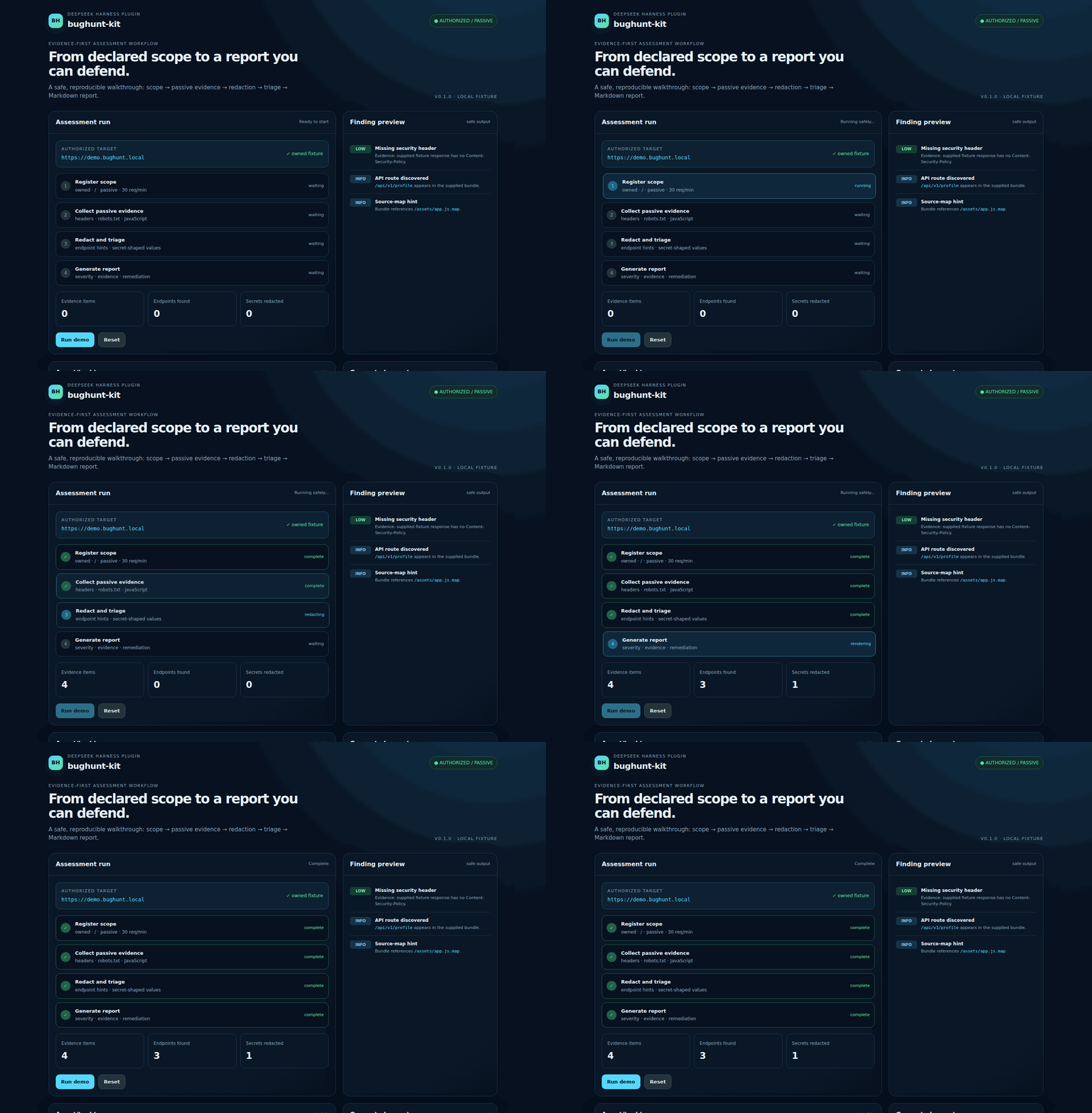
The demo shows the complete safe path: an owned local fixture, passive scope registration, evidence collection, redaction, endpoint triage, and Markdown report generation. It does not probe a public target and contains no exploit payloads.
Run it locally:
npm run demo:serve
# open http://127.0.0.1:18080 in a browser
# click "Run demo"
To regenerate screenshots and the GIF with Playwright:
PLAYWRIGHT_BROWSERS_PATH=/tmp/bughunt-playwright-browsers npm run demo:capture
See demo/README.md for the fixture details.
What v0.3 provides
Everything in v0.1 and v0.2, plus a local-only Web3 review module:
bughunt.decode-calldata: decode common EVM selectors and arguments from supplied calldata.bughunt.approval-risk: explain ERC-20 allowance and ERC-721 operator approval exposure.bughunt.contract-review: return a defensive smart-contract checklist covering access control, reentrancy, oracles, approvals, upgradeability, validation, errors, and evidence.bughunt-web3-review: methodology skill with strict no-signing/no-broadcast/no-exploit guardrails.- Web3 tools use no RPC, never request private keys, and never sign or submit transactions.
The original v0.1 and v0.2 tools remain available:
bughunt.scope: declare authorization, target paths, mode, and request budget before work starts.bughunt.analyze-js: extract endpoint and source-map hints from JavaScript text already supplied to the tool; no implicit fetching.bughunt.report: render collected evidence into a structured Markdown report.- Four bundled skills: authorization boundary, evidence triage, API inventory, and vulnerability reporting.
- Secret-shaped values are redacted before analysis output is returned.
Install from a checkout
dsh plugin --profile web add ./bughunt-kit
After installation, restart the DSH profile or use the host's plugin reload action.
Example workflow
Use the bughunt-authorized-assessment skill. The target is my local demo fixture.
Register a passive scope, analyze the supplied JavaScript bundle, and produce a
redacted Markdown report. Do not send requests outside the declared scope.
The tools are deliberately narrow. bughunt.analyze-js accepts text; it does not download a URL or execute JavaScript. Network reconnaissance and browser workflows should be explicitly composed by the user with a separate authorized tool and a declared scope.
Architecture
scope declaration
      ↓
passive evidence supplied by the user
      ↓
redaction + structured triage
      ↓
severity-ranked Markdown report
The Cordis bundle is additive. It registers tools and a skill provider without modifying DSH core configuration.
Development
npm install
npm test
npm run typecheck
npm run smoke
npm pack --dry-run
Every push and pull request runs the same checks in GitHub Actions: typecheck, tests, package smoke test, and SKILL.md frontmatter validation.
The package declares dsh.bundle.patch, so a published package can be installed with:
dsh plugin --profile web add bughunt-kit
Compatibility
The initial scaffold targets DSH 0.2.1-rc.2 and Node.js 20+. Update the compatibility matrix and run the smoke test before each release.
Roadmap
- v0.1: scoped passive evidence and report MVP
- v0.2: OpenAPI inventory and API trust-boundary review
- v0.3: local Web3 calldata, approval-risk explanation, and smart-contract checklist
- v0.4: optional Web UI for assessment history and evidence counts
License
MIT. See LICENSE and SECURITY.md.
No comments yet. Be the first to write one.